
What is an unshaven hair transplant?
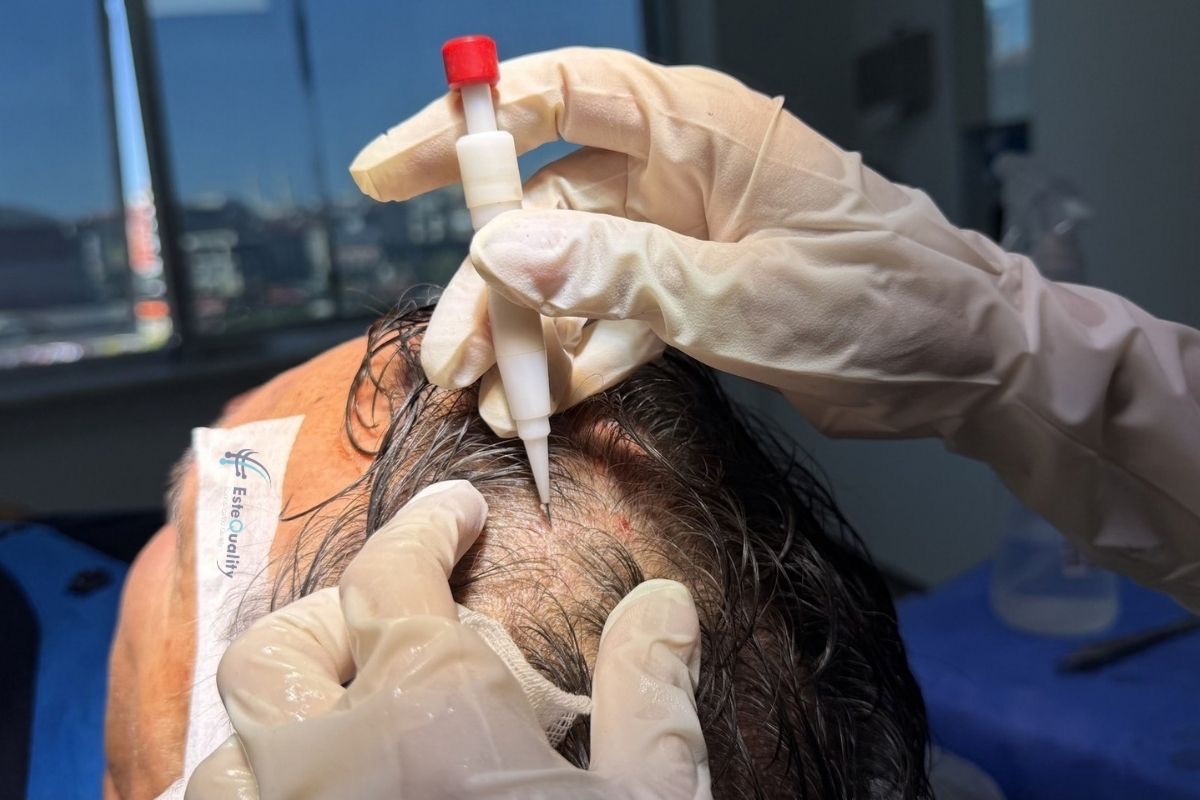
An unshaven hair transplant is a hair transplant done without shaving the area that receives the grafts. The grafts are placed between your existing hairs, and your own hair covers the treated zone from the first day. At EsteQuality we do this with DHI, where an implanter pen opens the site and places the graft in one motion, which is what makes working between existing hairs practical [1].
The word “unshaven” describes the recipient area. The donor area at the back of the head still has to be trimmed where grafts are taken, but only in narrow strips that stay hidden under the surrounding hair; once the hair is washed and dried the day after surgery, those strips are not visible.
- Since 2016, caring for international patients
- Specialist-led, under the leadership of a plastic surgery specialist (plastic, reconstructive and aesthetic surgery), planning and design are carried out by physicians certified in hair transplantation
- Hospital environment, procedures in a fully equipped hospital
- 12-month follow-up, with a clear revision policy
- Languages, English, Turkish, German, Spanish, Russian, Romanian
How it works without shaving
The session runs in the same three stages as any FUE-based transplant, under local anesthetic: harvesting, opening the sites, and placing the grafts [2]. What changes is how the first and third stages are done.
Harvesting: instead of shaving the whole donor area, the physician trims a few narrow strips inside it, chosen so that the longer hair above and around them falls over the trimmed zones. Grafts are taken from these strips one by one.
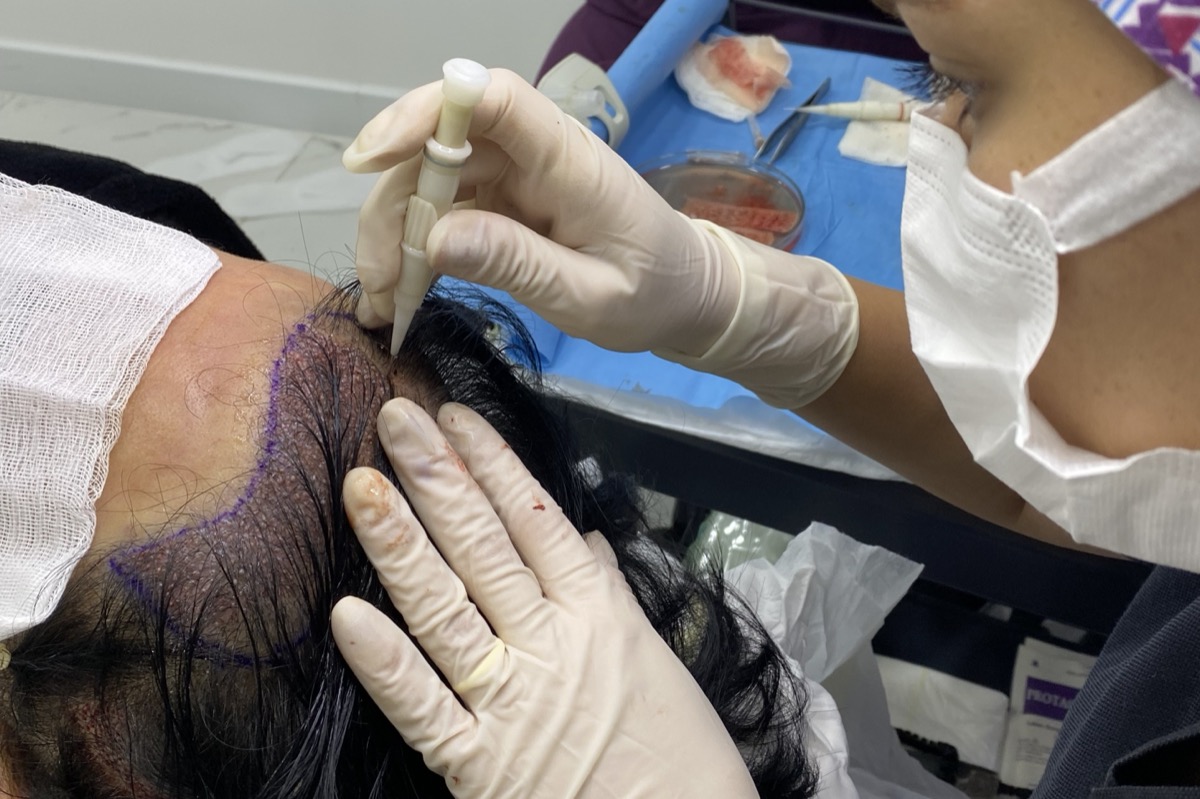
Placing: with the implanter pen, each graft is loaded and set directly between the existing hairs of the recipient area, so no channels have to be opened in advance and nothing has to be shaved to see the skin [1]. This is slower than working on a shaved scalp, because the physician is working around hair that is in the way. A typical unshaven session therefore covers fewer grafts than a shaved one and takes longer for the same number.
For the technique itself, see our DHI hair transplant page; for the donor area, see beard-to-scalp hair transplant if you are short of scalp donor.
Who is a good candidate?
Unshaven DHI is chosen most often by people with longer hair who want the procedure to stay private, by women, who rarely accept a shaved recipient area, and by anyone who cannot take time away from work while short hair grows back. It suits hairline work, temples, the front and mid-scalp, and adding density into an area that still has hair.
It is not the right choice for every case. A fully unshaven procedure, with a hidden window in the donor area, suits plans of up to about 3,000 grafts. Up to about 5,000 grafts, the top can stay unshaven while the sides and back are shaved; larger plans are usually done fully shaved, because the extra time an unshaven session takes grows with every graft. If your loss is still advancing quickly, if your donor is limited, or if a medical cause of shedding has not been ruled out, we say so at the assessment; the shaving question does not change those fundamentals [3][4]. Women with hair loss have their own page: hair transplant for women.
Common claims about unshaven transplants, checked
- “Nobody will notice anything.” Your own hair covers the recipient area from the first day, and the donor strips are hidden, so the change is far less visible than with a shaved head. Some redness, small crusts around the grafts and mild swelling are still there in the first week; they are simply covered.
- “Unshaven means no downtime.” Most patients are back at work within a few days, but the early-care rules (no rubbing, no sun, no heavy exercise for the first two weeks) are the same as for any transplant.
- “Unshaven gives a weaker result.” The grafts are the same and heal the same way; what differs is how many can be placed in one session. Where a plan needs more grafts than one unshaven session allows, we say so rather than under-fill the area.
- “Unshaven costs more.” At EsteQuality it does not; the price follows the graft count, the technique and the package, not whether the head is shaved.
Recovery and results timeline
Healing follows the ordinary FUE path: crusts form around the grafts and clear within the first two weeks; the transplanted hairs shed between roughly the second and fourth week; new growth starts around the third to fourth month; and the result keeps filling in until about month 12 [2][5]. The difference with an unshaven procedure is that your existing hair covers each of these stages.
The day-by-day care instructions, the washing routine and our 12-month follow-up and revision policy are the same as for every technique and are set out on our hair transplant in Turkey page.
Cost
Pricing follows our standard structure: procedure only from €1,700, and an all-inclusive package from €2,100 (accommodation, transfers, medication and aftercare included). Unshaven procedures are done with DHI, so the DHI supplement applies (+€200 up to 3,000 grafts, +€500 above); the final figure depends on the number of grafts and the technique planned at your consultation. The full breakdown is on our hair transplant packages in Turkey page.
Unshaven hair transplant in Turkey and how care is supervised
Under the leadership of a plastic surgery specialist (plastic, reconstructive and aesthetic surgery), the planning and hairline design are carried out by physicians certified in hair transplantation, inside a fully equipped hospital environment [6]. The physician performs the donor extraction and the pen implantation, placing each graft with the implanter pen. The procedure is done under local anesthetic; if you prefer, it can be performed with sedation for a more comfortable experience. The stay in Istanbul, screening and the post-operative care pack are described on our hair transplant in Turkey page.
Before and after: a patient’s story
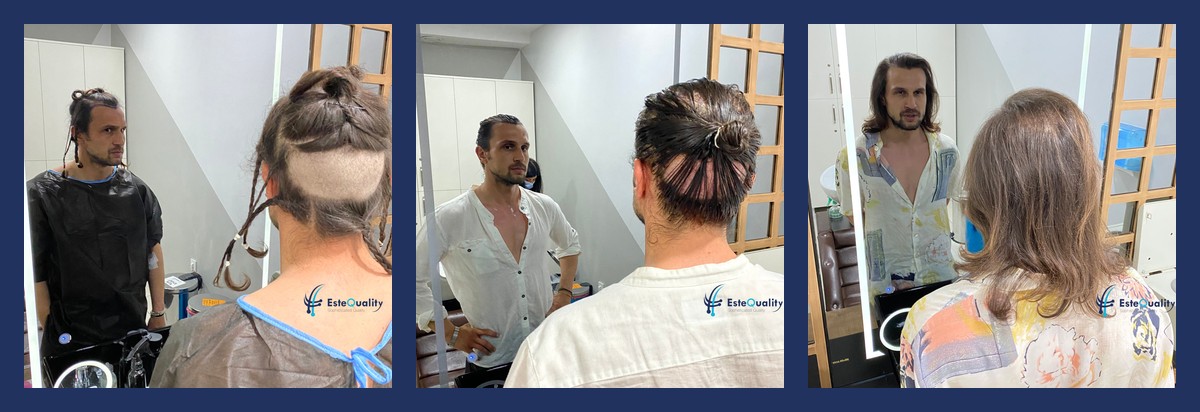
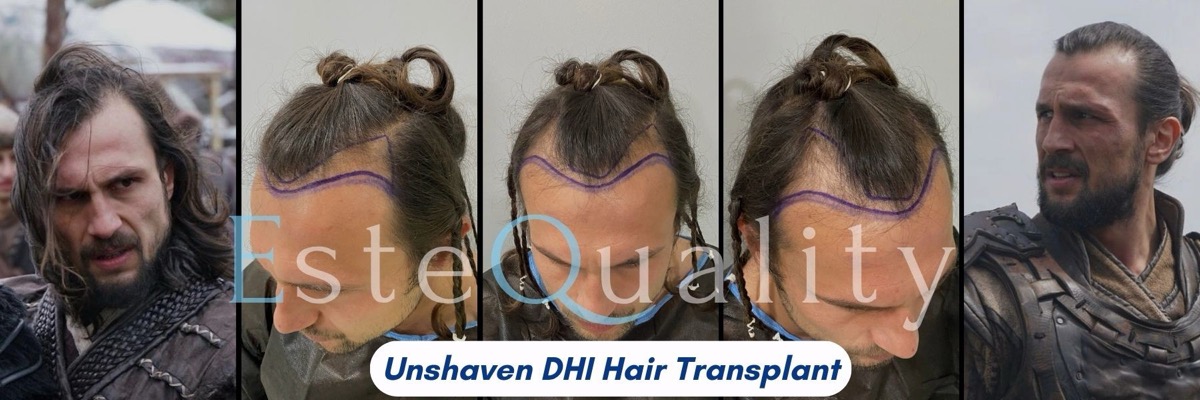
Burak, an actor, had 2,750 grafts placed with unshaven DHI along the hairline and front. He asked for the procedure because he could not appear on set with a shaved head; his long hair covered the treated area throughout. The donor photos at the top of this page show his donor area on the day of surgery, the day after and at twelve days; below, his hairline before and at twelve months. He has agreed to be shown by name. Results vary from person to person; his case is shown because it illustrates the unshaven approach, not because it predicts yours.
Frequently asked questions
Do you have to shave your head for a hair transplant?
Not necessarily. In an unshaven DHI the recipient area is not shaved at all; only narrow strips in the donor area are trimmed and they stay hidden under your hair.
How many grafts can be done unshaven?
Fewer than in a shaved session, because placing grafts between existing hairs is slower. Up to about 3,000 grafts can be done fully unshaven; up to about 5,000 with the top unshaven and the sides and back shaved; larger plans are done fully shaved. We tell you which applies to you at the assessment.
Is unshaven DHI suitable for women?
Yes; it is the approach most women choose, because the existing hair is kept. See our hair transplant for women page for causes and candidacy.
Does it hurt?
The procedure is done under local anesthetic, so you should not feel pain once the area is numb; you may feel the injections. Sedation is available if you prefer.
When can I go back to work?
Most patients return within a few days, as the treated area is covered by their own hair. Avoid heavy exercise, swimming and direct sun for the first two weeks.
Can a second session be done unshaven if I have had a transplant before?
It depends on how the first session was done. If the first procedure was unshaven and grafts were taken from a limited part of the donor area, a second unshaven session is usually possible. If the first procedure was shaved and grafts were taken from across a wide donor area, a second session cannot be done unshaven from the scalp. In that case, if you still want to avoid shaving, the beard is used as the donor instead of the scalp, so the hair on the head is not trimmed at all; see our beard-to-scalp hair transplant page.
Does an unshaven transplant cost more?
No. The price follows the graft count, the technique and the package you choose.
Sources
- ISHRS, FUE variants (DHI implanter pen vs channel-first FUE) as refinements of follicular unit extraction.
- AAD, Hair transplant: what to expect, grafts, shedding and regrowth timeline.
- NHS, Male and female pattern baldness; when the pattern stabilizes.
- NHS, Causes of hair loss (pattern loss vs telogen effluvium / medical causes).
- NHS / Mayo Clinic, Risks and recovery after hair transplant surgery (swelling, crusting, shock loss).
- ISHRS, Hair transplant surgery must be performed/supervised by a licensed physician.


