
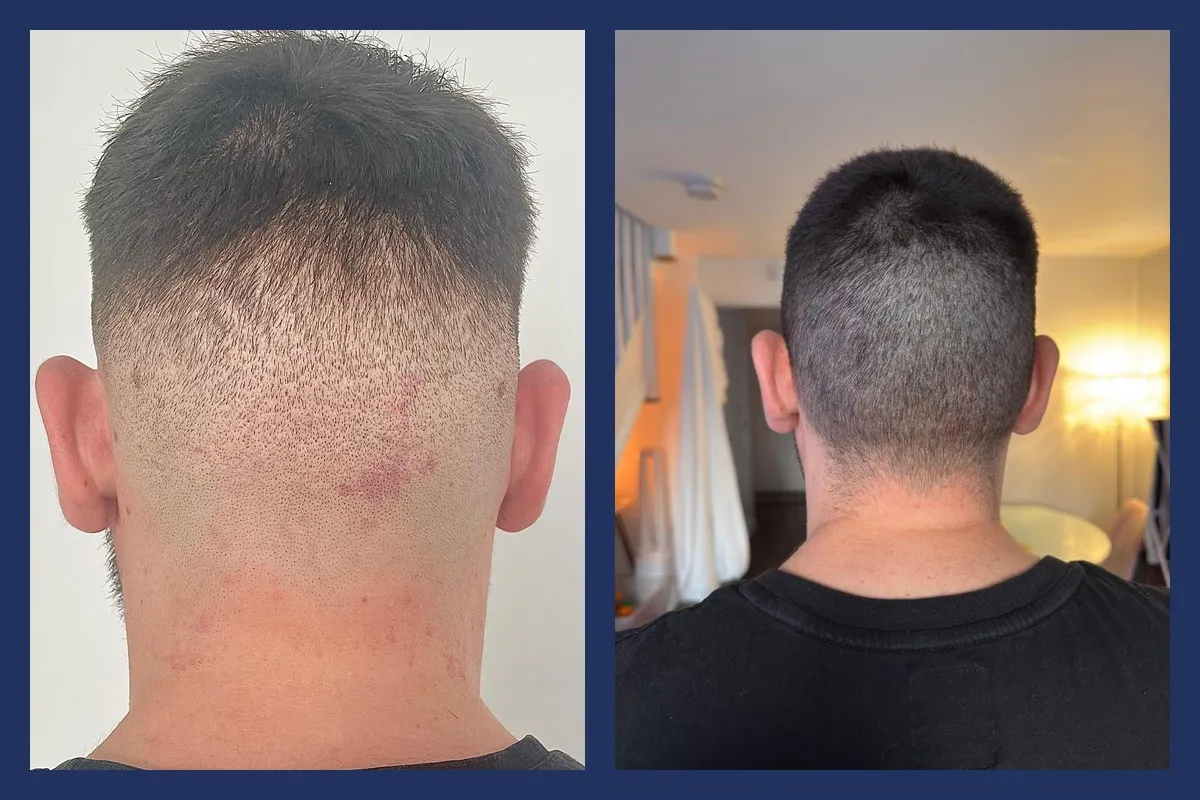
What donor area repair can do
Donor area repair is for people whose donor area (the back and sides of the scalp) is too thin, patchy or unevenly harvested after an earlier hair transplant, often one done at another clinic. If that describes you, you are not alone, and the aim here is to help rather than to judge how it happened. The goal of donor repair is a more even, homogeneous look across the donor area, not a return to the density you had before your first procedure [1].
We do this by taking grafts from your scalp (any donor zones that have not been over-harvested) and from your beard, and placing them into the thinned patches to balance the area. We use only scalp and beard hair as donor sources; we do not take grafts from body hair. Published comparisons report lower survival and growth for chest and body hair grafts than for scalp or beard grafts, and body hair has a shorter growth cycle and finer calibre; this is why we use scalp and beard only [5][6].
- Since 2016, caring for international patients
- Specialist-led, under the leadership of a plastic surgery specialist (plastic, reconstructive and aesthetic surgery), planning and design are carried out by physicians certified in hair transplantation
- Hospital environment, procedures in a fully equipped hospital
- 12-month follow-up, with a clear revision policy
- Languages, English, Turkish, German, Russian, Romanian
How we assess your case
The assessment happens in two steps. First, you can send photos for a remote pre-assessment, where we give you an honest, average expectation of what repair could achieve for a donor like yours. Then, at a physical examination, the donor is checked closely with dermoscopy to judge the density, the pattern of damage, and how much scalp and beard could be used.
What can usually be repaired: small areas, scars, and a mildly damaged donor. What generally cannot: a wide, heavily damaged donor when there is not enough alternative donor (scalp and beard) left to draw from. If your case falls into the second group, we tell you that plainly rather than start a repair that cannot deliver.
Who it is for
Donor repair suits a specific problem rather than everyone. It may be for you if an earlier transplant left the donor looking see-through or patchy, if too many grafts were taken from one area, or if the extraction pattern was uneven. It is not suitable if you do not have enough scalp and beard donor to draw from. If you have an active scalp or skin condition, that is treated first and the repair is assessed afterwards [2].
When repair can be done
Timing matters. We do not work on a fresh scar or a recently operated donor; the tissue needs to mature first, so we wait at least 6 months before a repair [1]. During that waiting time, supportive measures such as a silicone scar gel and PRP or mesotherapy may help the area settle, though they do not replace the repair itself.
How the repair works
The donor is filled rather than harvested. Grafts are taken from the beard (and, where needed, from untouched parts of the scalp donor) and implanted into the thin areas, usually with the DHI implanter technique, which lets us place grafts one by one between existing hairs.
- Assessment and plan. We map the thinned patches and work out how many grafts your beard and remaining scalp can spare, then design where each goes to even out the area.
- Extraction. Grafts are removed one at a time from the beard (usually the neck and lower jaw) and from any untouched scalp donor, under local anesthetic.
- Placement into the donor. The grafts are placed into the thinned patches at the right angle and direction so they blend with the surrounding hair.
In a single session, a donor repair typically moves 1,000 to 3,500 grafts, of which the beard can usually supply around 1,000 to 2,500; the work is planned to your donor capacity rather than to a fixed maximum, and the exact number is set at the assessment. Between extraction and implantation, grafts are stored in chilled lactated Ringer’s solution at 4–5 °C, one of the standard holding solutions in hair transplantation, to limit the time they spend outside the body.
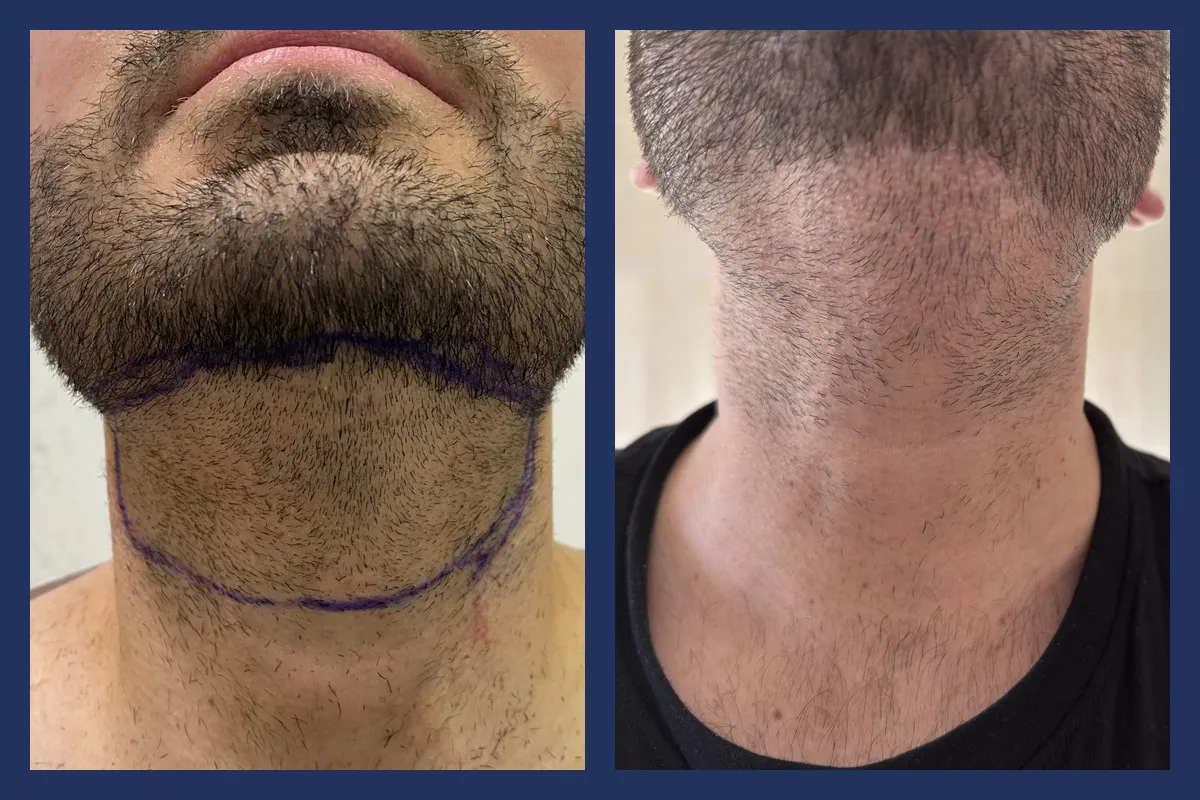
Will my head be shaved?
It depends on where the grafts come from. If the repair uses beard grafts only, the hair on your head is not cut at all. If we also need grafts from the scalp donor, the top of your head is not shaved; only the sides and back are trimmed, and both the extraction and the placement are done in that area. We keep any shaving to the minimum the plan needs.
What results to expect
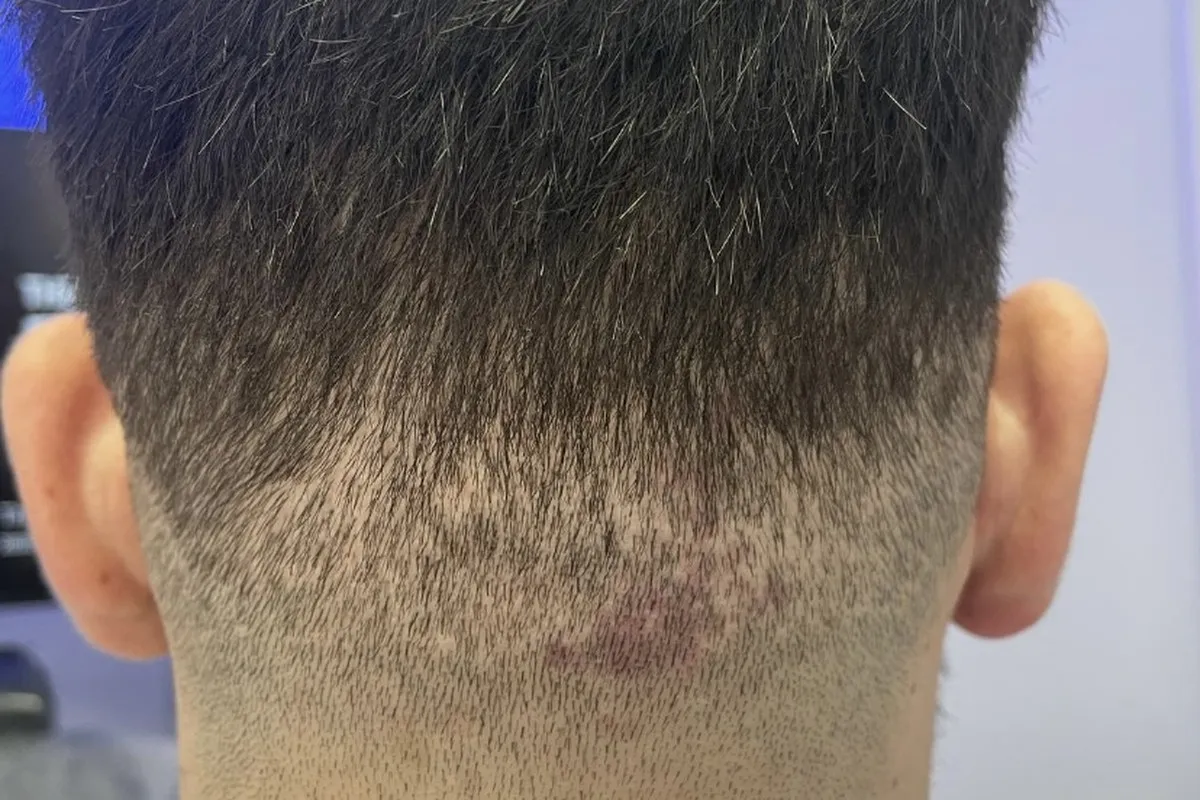
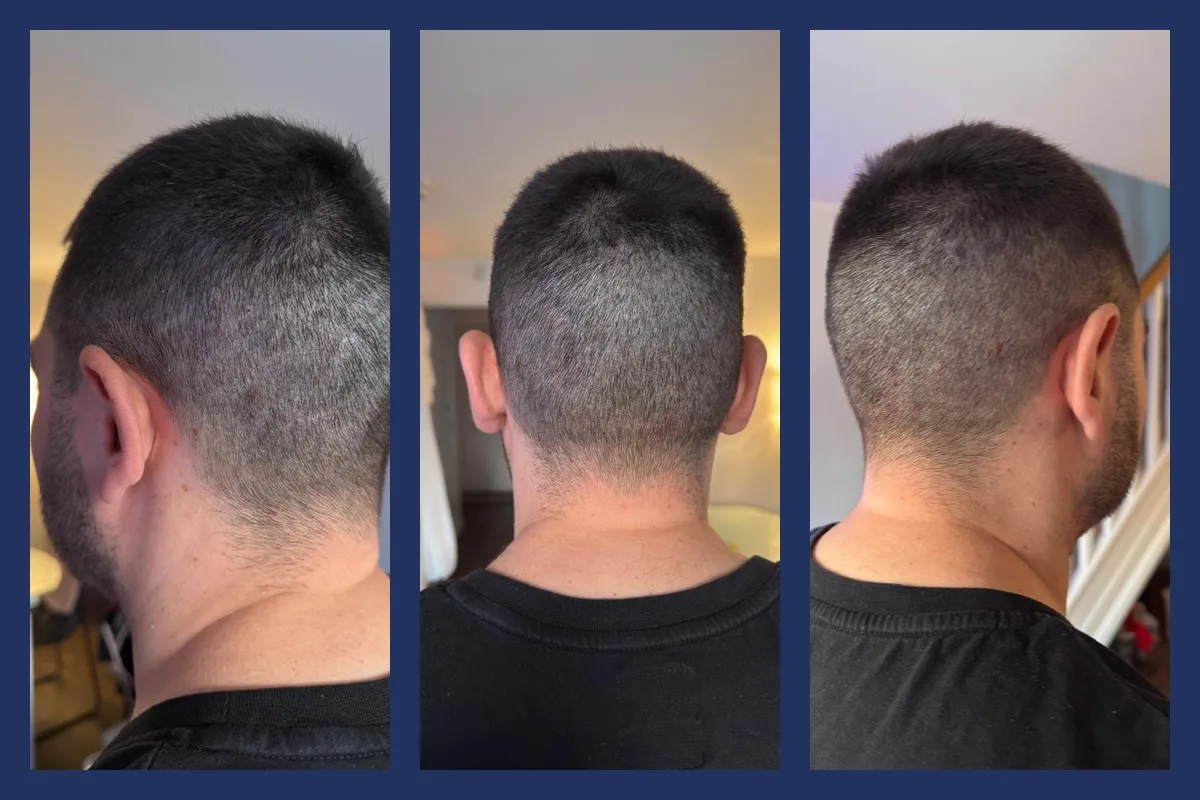
A realistic, good outcome is a donor that looks more even and homogeneous, not one restored to the density it had before grafts were taken. If, once the hair has grown, an area still looks uneven, scalp micropigmentation (SMP) can reduce the remaining contrast; we do not perform SMP at EsteQuality, and it would be a separate step done elsewhere, at least 6 months after the beard-to-donor repair so the grafts have settled first.
Recovery
The beard donor area usually settles within about 5 days, faster than the scalp donor. The repaired donor itself then follows the normal hair transplant recovery timeline, early shock shedding, regrowth over the following months, and a settled result at around 9 to 12 months [2]. As with any procedure there are limits and some risk (swelling, redness, numbness, and, less often, infection), and outcomes vary with how much scalp and beard you have to work with [2]. The full recovery timeline and our 12-month follow-up and revision policy are set out on our hair transplant in Turkey page.
If you want to understand the underlying problem first, our overharvested donor area guide explains the signs of an over-harvested donor and how to tell.
Cost
Donor repair is quoted individually, because a small evening-out and a larger rebuild are very different amounts of work. The procedure alone starts from €1,700 and an all-inclusive package from €2,100 (up to €4,200), updated September 2026; repair plans are quoted against that framework. See our hair transplant packages in Turkey page, and message us on WhatsApp for a tailored plan.
Frequently asked questions
Can an overharvested donor area be fully restored?
Partly. Restoring the donor completely would need roughly as many grafts as were originally taken, which is rarely available; a repair that looks even and natural usually needs considerably fewer. Full restoration and repair are different goals, and we plan for the second [1].
Where do the grafts for a donor repair come from?
From your beard (neck and lower jaw) and from any scalp donor that has not been over-harvested. We do not use body hair, because of the marks and pigment mismatch it can leave and its lower yield.
How long do I have to wait after my first transplant?
At least 6 months, so the tissue has matured before we work on it. A silicone scar gel and PRP or mesotherapy may support the area in the meantime.
How many grafts will I need?
Typically 1,000 to 3,500 grafts in a single session, of which the beard can usually supply around 1,000 to 2,500; it is planned to your donor capacity, with no fixed number promised.
Can a donor damaged at another clinic be repaired here?
Yes. All of the donor repairs we have performed so far have been for patients treated at other clinics; we assess the donor as it is now, whatever technique was used originally.
Sources
- ISHRS, Hair transplant patient information (donor area assessment, beard donor sources). https://ishrs.org/patients/
- AAD, Hair loss: diagnosis and treatment (hair transplant, recovery, risks and outcomes). https://www.aad.org/public/diseases/hair-loss/treatment/diagnosis-treatment
- NHS, Hair loss (when to seek advice). https://www.nhs.uk/conditions/hair-loss/
- Mayo Clinic, Hair loss (treatments and realistic expectations). https://www.mayoclinic.org/diseases-conditions/hair-loss/symptoms-causes/syc-20372926
- ISHRS, Body Hair Transplant. https://ishrs.org/body-hair-transplant-2/
- J Cutan Aesthet Surg 2019, comparative study of anagen effluvium and survival of scalp, beard and chest hair grafts. https://pmc.ncbi.nlm.nih.gov/articles/PMC6676805/


