
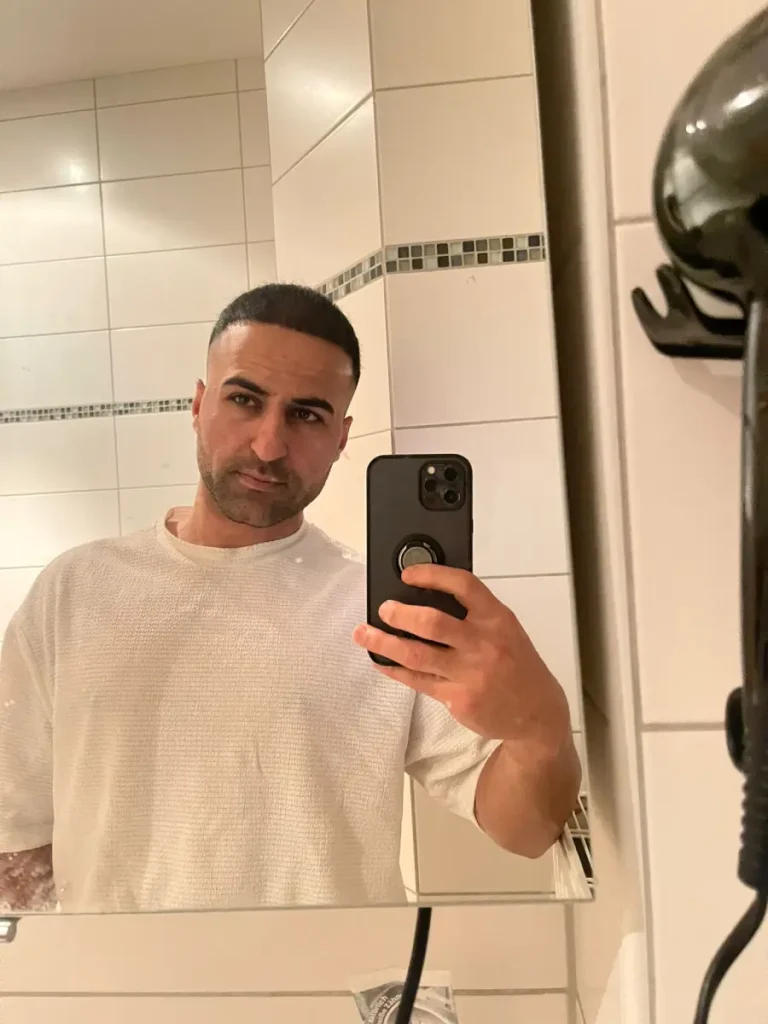
TL;DR: A buzz cut hair transplant is the ultimate test of surgical precision, as it eliminates the possibility of using long hair to camouflage technical errors. By utilizing 2026 AI-driven mapping and ultra-refined Sapphire FUE or DHI techniques, this procedure creates a high-density, “unmaskable” hairline that looks completely natural even at a 3-mm length. The success of this style depends entirely on anatomical exit angles and intentional micro-irregularities in the hairline.
What Exactly Is a Buzz Cut Hair Transplant?
It is a specialized hair restoration protocol designed for patients who prefer a short-cropped (Grade 1-3) hairstyle, requiring high-density graft placement and perfect angular alignment that mimics the scalp’s natural growth pattern without the help of hair length for coverage.
While traditional transplants often rely on neighboring long hairs to create an illusion of density, the Buzz Cut Transplant leaves every graft exposed. In 2026, this has become the “gold standard” for masculine aesthetics. The procedure focuses on:
- Exit Angle Precision: Grafts are placed at a shallow 15° to 25° angle to ensure they lay flat against the scalp, avoiding the “doll hair” effect.
- Shadow Density: Ensuring the $cm^2$ density is high enough to create a consistent “hair shadow” across the scalp under direct lighting.
- Zero-Scar Harvesting: Utilizing 0.6mm-0.7mm punches to ensure the donor area remains pristine even when shaved close.
Why Is the “Micro-Irregularity” Concept Essential for Short Hair?
Micro-irregularity refers to the intentional, non-linear placement of single follicles at the very front of the hairline to replicate the natural, slightly “jagged” look of a non-transplanted scalp. In nature, a hairline is never a straight line. If a surgeon creates a perfectly straight border, it becomes immediately detectable as a transplant once the hair is buzzed.
- 2026 Design Protocol: We use AI-Anatomical Mapping to identify the patient’s original “forehead-to-peak” ratio.
- Single Graft Exclusion: Only single-hair follicles are used in the first 5–10 mm of the hairline.
- Irregular Macro-Patterning: We create small “protrusions” and “indentations” in the hairline to break the light, making it impossible for the naked eye to distinguish eked hair from original hair.
What Are the Key Benefits of Choosing a Buzz Cut Style?
The Buzz Cut style offers a modern, low-maintenance aesthetic that emphasizes facial structure, provides an “unmaskable” look under harsh lighting, and eliminates the daily stress of styling or concealing thinning areas.
Choosing this specific path in 2026 is often a lifestyle decision for the modern professional. The advantages include:
- Structural Symmetry: Short hair draws attention to the jawline and eyes rather than the scalp.
- Weather Resistance: No more worrying about wind, rain, or humidity affecting your hairstyle.
- The “Never-Thinning” Look: Because the hair is kept at a consistent short length, the transition between transplanted and native hair is virtually invisible.
- Cost & Time Efficiency: Zero spend on styling products and significantly reduced time in front of the mirror.
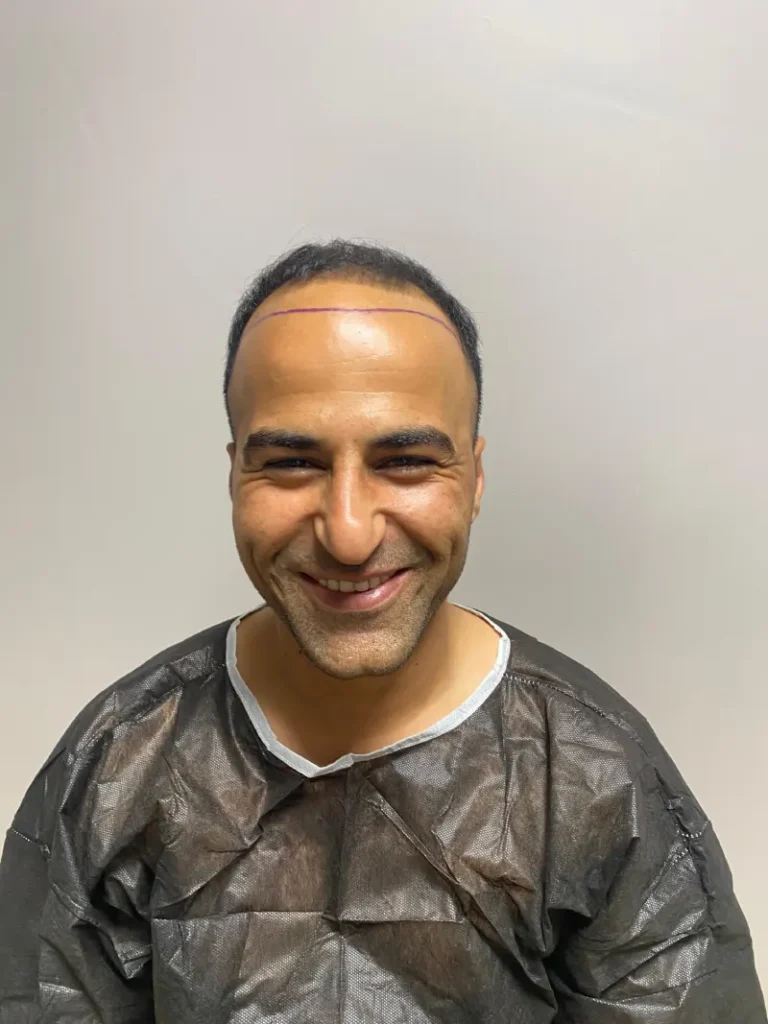
Estequality Case Study: A Step-by-Step Transformation
Our clinical process transitions from precise anatomical mapping to high-density implantation, ensuring that the transition from a receding hairline to a full, buzzed look is mathematically harmonious and biologically natural.
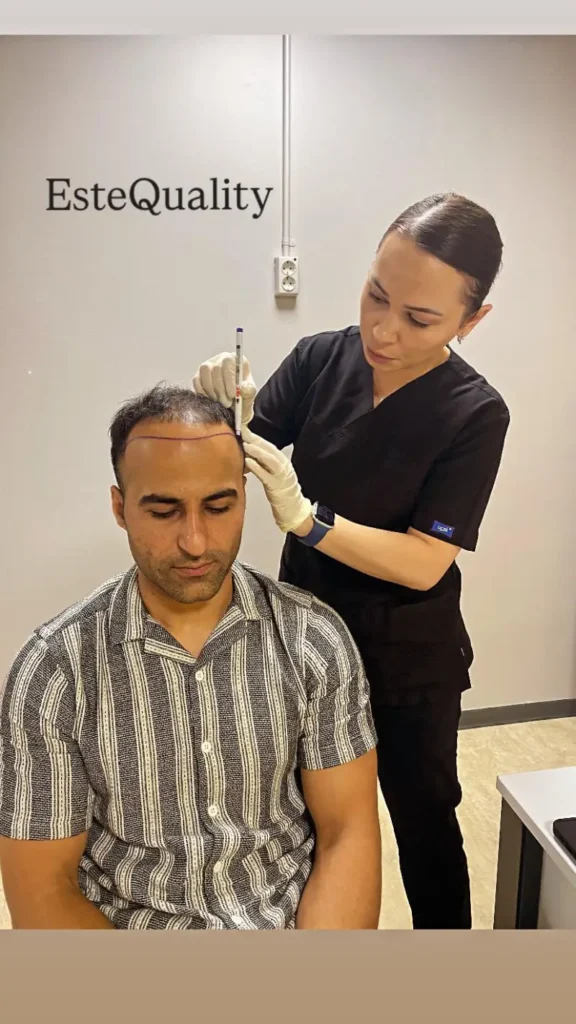
Phase 1: Anatomical Hairline Design
This phase involves using the “Golden Ratio” to mark a hairline that respects the patient’s aging process while restoring a youthful, masculine frame to the face.
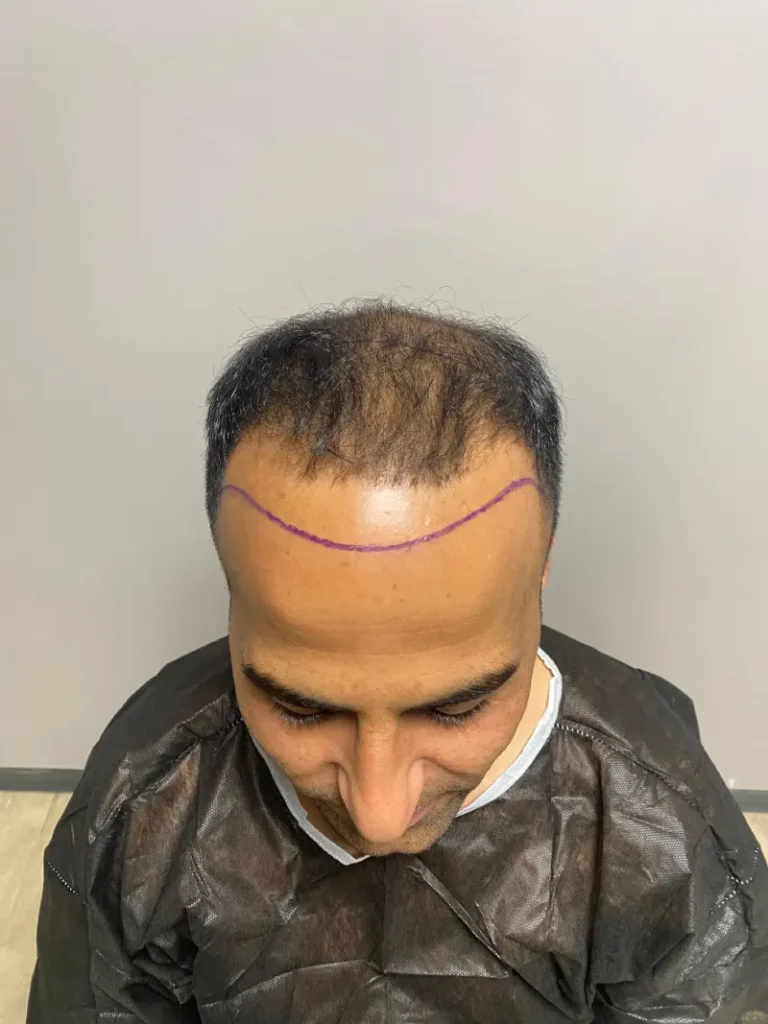
As seen in our clinical prep, the design is not just a line; it is a blueprint for the face.
- The Marking: We use a purple surgical marker to define the “Safe Zone” and the new transition point.
- The Curve: Note the slight temporal recession kept in the design; a “perfectly straight” line looks fake, but a slightly curved, masculine peak ensures 100% naturalness.
Phase 2: High-Density Implantation and Natural Angle Alignment
During this stage, grafts are placed with microscopic precision to ensure the “density shadow” is uniform across the entire recipient area.
| Feature | Technical Requirement | Estequality Standard |
| Graft Spacing | Less than 1mm between follicles | Ultra-High Density |
| Angle | Shallow 20-degree exit | 360-degree Vortex Mapping |
| Graft Type | Single follicles at the front | 100% Single-Hair Refinement |
Phase 3: The Final Reveal – A Sharp, Masculine Look
The end result is a high-definition hairline that remains crisp and dense even when shaved to a 3mm or 5mm length. The final transformation showcases the success of the Estequality approach:
- Density Check: Under direct indoor lighting, the “fill” is consistent with no patchy areas.
- Styling Versatility: Even with a “Skin Fade” on the sides, the top maintains a strong, defined presence that balances the patient’s features.
We conclude our guide with the technical selection process and the strategic reasons why a precision-focused clinic is vital for this specific look.
Which Technique Is Best for Buzz Cut Results: DHI or Sapphire?
For a Buzz Cut result, DHI (Direct Hair Implantation) is generally superior for creating high-density hairlines, while Sapphire FUE is preferred for larger recipient areas where precise channel angling is required to ensure the hair lays flat. In the 2026 clinical landscape, we often utilize a Hybrid Approach to achieve the result seen in our case study:
- DHI for the Frontal Rim: Using the Choi Implanter pen allows for $360^{\circ}$ control over the angle and depth, essential for that crisp, short-haired edge.
- Sapphire for the Bridge: Sapphire blades create V-shaped micro-channels that minimize trauma and allow for closer graft placement, ensuring no “gaps” are visible when the hair is short.
- Healing Advantage: Both techniques ensure that post-operative redness and scabbing are minimized, allowing patients to return to their “buzzed” look faster.
Who Is the Ideal Candidate for This Short-Hair Procedure?
The ideal candidate is an individual with stable hair loss, a strong donor area (typically Grade 1 or 2 on the Norwood scale), and a preference for modern, athletic, or low-maintenance hairstyles.
| Candidate Feature | Buzz Cut Transplant | Long Hair Transplant |
| Daily Styling | Zero maintenance required | Requires products/blow-drying |
| Detection Risk | Virtually zero with proper angling | High if the wind blows or hair is wet |
| Facial Focus | Enhances jawline and symmetry | Frames the face with volume |
| Donor Usage | Efficient; requires high quality, not quantity | Requires high volume for length coverage |
Why Choose Estequality for Your Precision Hair Transplant?
Estequality specializes in “High-Definition” results, combining AI-driven design with surgical artistry to ensure your hair looks as natural at 3mm as it does at 3cm. As demonstrated by our patient’s journey—from the meticulous initial mapping to the confident, finished look—we prioritize three pillars:
- Bespoke Mapping: We don’t use templates. Every hairline is hand-drawn to match your unique bone structure.
- Angular Integrity: We guarantee that every graft follows the natural “flow” of your scalp, preventing any unnatural growth patterns.
- Future-Proof Planning: We design with your future aging in mind, ensuring the hairline looks appropriate as you mature.

