
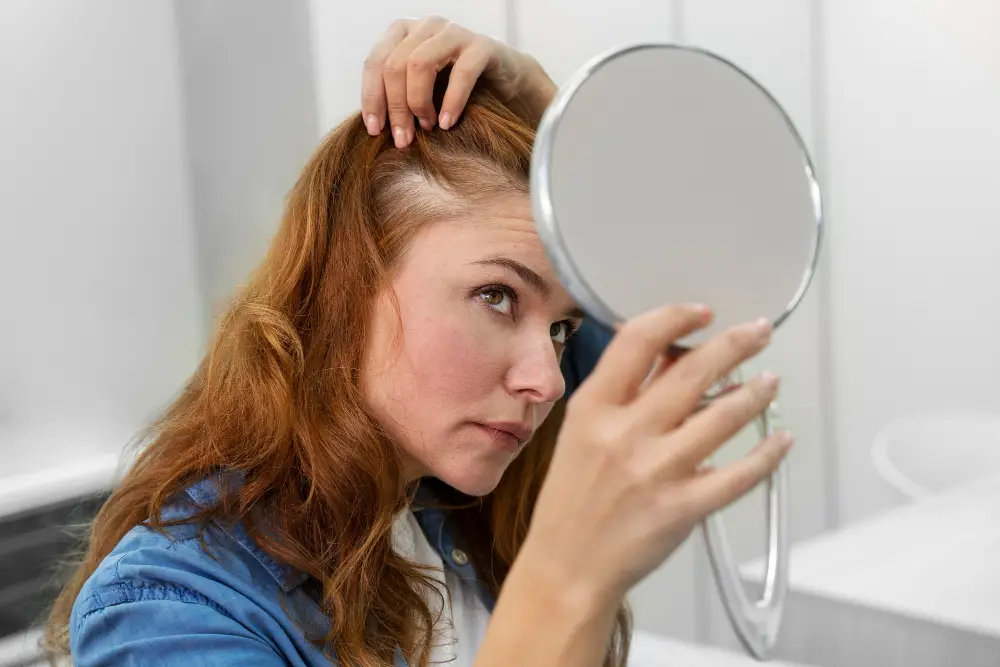
TL;DR: A widening hair part means the scalp is becoming more visible along the part line, usually because hair density is decreasing in that area. It is especially common in women and can be linked to female pattern hair loss, stress shedding, low iron, thyroid imbalance, postpartum changes, PCOS, menopause, tight hairstyles, or scalp inflammation. A widening part is not always permanent, but it should not be ignored if it keeps getting wider over months. The right treatment depends on the cause: temporary shedding may recover, while progressive density loss may need medical treatment, regenerative support, or hair restoration planning.
What is a widening hair part?
A widening hair part means the scalp becomes more visible along the line where the hair is parted. This can happen when hair density decreases around the part line, crown, or top of the scalp. In early stages, it may only be visible under bathroom lighting, in photos, or when the hair is freshly washed. A normal part line can look slightly different depending on lighting, oiliness, hairstyle, and hair color. The concern starts when the same part keeps looking wider over time.
Common signs include:
- More visible scalp along the part
- A brighter part line in photos
- Less volume at the crown
- Hair looking flatter than before
- A thinner ponytail
- More effort needed to cover the scalp
- The part line widening over months
The key point is simple: a widening part is not just a styling issue if the scalp visibility keeps increasing.
Is a widening hair part a sign of hair loss?
Yes, a widening hair part can be an early sign of hair loss. It does not always mean permanent hair loss, but it often means the density around the part line is changing. This may happen because of temporary shedding, female pattern hair loss, nutritional deficiency, hormonal changes, or scalp inflammation. Some patients confuse normal shedding with true density loss. Shedding means more hairs fall out. A widening part means the scalp is becoming more visible in a specific area. If you are unsure which one is happening, understanding thedifference between shedding and real hair loss can help clarify the next step. A widening part becomes more concerning when it is progressive. If the part line keeps expanding, the crown looks thinner, or styling no longer hides the scalp, the cause should be evaluated.
What causes a widening hair part?
A widening hair part can be caused by female pattern hair loss, stress shedding, hormonal changes, low iron, thyroid problems, PCOS, postpartum shedding, traction, or scalp inflammation. There is rarely one universal cause. The same visible symptom can come from different conditions, which is why diagnosis matters.
Common causes include:
- Female pattern hair loss
- Telogen effluvium
- Low ferritin or iron deficiency
- Vitamin D, B12, zinc, or protein deficiency
- Thyroid imbalance
- PCOS
- Postpartum hair loss
- Menopause-related thinning
- Tight hairstyles or extensions
- Scalp inflammation
- Chemical or heat damage
- Chronic stress or rapid weight loss
Hair density can also feel worse when hair growth slows, strands become finer, or the growth cycle becomes weaker. Patients noticing both slow growth and part-line thinning may benefit from learning more aboutslow hair growth and density changes. The practical message is clear: the part line is the visible clue, but the real cause may be hormonal, nutritional, mechanical, inflammatory, or genetic.
Why is a widening part more common in women?
A widening part is common in women because female pattern hair loss often appears as diffuse thinning along the part line instead of a receding hairline. Men often notice a receding hairline or crown bald spot. Women more commonly notice reduced density on the top of the scalp, a wider middle part, or less volume around the crown. This pattern can develop slowly. At first, the hair may still look normal when styled. Later, the scalp becomes harder to cover, especially under direct light.
A widening part in women may be linked with:
- Genetic sensitivity
- Hormonal changes
- Menopause
- PCOS
- Postpartum shedding
- Iron deficiency
- Thyroid imbalance
- Long-term traction from hairstyles
This is why women should not wait until the scalp is clearly visible. Early diagnosis gives more treatment options.
How can you tell if your hair part is getting wider?
You can tell your hair part is widening if the same part line shows more scalp over time. The best way is to compare the same hairstyle, lighting, angle, and camera distance every month. Random photos can be misleading because flash, oily roots, wet hair, or harsh lighting can make any part look wider.
Useful self-checks include:
| What to check | What it may suggest |
| More scalp along the same part | Possible density loss |
| Wider part in monthly photos | Progressive thinning |
| Flatter crown | Reduced top density |
| Thinner ponytail | Diffuse density reduction |
| More scalp under bathroom light | Early visible thinning |
| Hair no longer holds volume | Miniaturization or breakage |
| More styling needed to hide scalp | Density change |
A single bad hair day is not enough to diagnose hair loss. A part line that keeps widening over several months is more meaningful.
Is a widening hair part permanent?
A widening hair part is not always permanent. If the cause is temporary shedding, stress, rapid weight loss, postpartum changes, or a correctable deficiency, density may improve once the trigger is treated. The follicles are often still active in these cases. If the cause is female pattern hair loss, the condition can progress without treatment. The part line may slowly widen, the crown may become flatter, and the scalp may become more visible over time.
A widening part is more likely to improve when:
- The trigger is recent
- Shedding is diffuse
- The follicles are still active
- Deficiencies are corrected
- Scalp inflammation is treated
- Tight hairstyles are stopped early
It is more likely to be progressive when:
- The part has widened for years
- There is family history of thinning
- The crown is losing density
- Hair strands are becoming finer
- The widening continues despite better care
- Menopause or hormonal changes are involved
The safest answer is this: a widening part can be reversible, but progressive part-line thinning needs early evaluation.
What is the difference between normal shedding and a widening part?
Normal shedding means more hair fall, while a widening part means visible density loss along the scalp parting. This difference matters because people often panic when they see hair in the shower. Shedding can be temporary. A widening part suggests that the scalp is becoming more visible, which may mean density is decreasing.
| Sign | Normal shedding | Widening part |
| More hair in the shower | Yes | Sometimes |
| More hair on the brush | Yes | Sometimes |
| Scalp more visible | Usually no | Yes |
| Part line gets wider | No | Yes |
| Crown looks flatter | Usually no | Often |
| Ponytail feels thinner | Sometimes | Often |
| Pattern worsens over time | Usually no | Often |
| Needs diagnosis | If persistent | Yes |
The key rule is simple: hair fall is about quantity, but a widening part is about visible density.
Can stress or weight loss make your hair part wider?
Stress or weight loss can make the part look wider if they trigger diffuse shedding. This usually happens through telogen effluvium, where more hairs shift into the shedding phase after a physical or emotional trigger. The part may look wider because overall density decreases across the scalp.
Common triggers include:
- Emotional stress
- Illness or fever
- Rapid weight loss
- Very low-calorie dieting
- Surgery
- Postpartum changes
- Poor sleep
- Low protein intake
The important distinction is timing. Stress or weight-loss shedding usually starts a few months after the trigger. If the part line continues to widen long after the trigger has passed, another cause may also be present.
Can low iron or vitamin deficiency cause a widening part?
Low ferritin, iron deficiency, vitamin D deficiency, B12 deficiency, zinc deficiency, or low protein intake can contribute to diffuse thinning and make the part look wider. Hair growth depends on adequate nutrition. When the body lacks key nutrients, hair production may slow and shedding may increase. This can make the part line look wider, especially in women who already have a tendency toward diffuse thinning.
Nutrients often checked in persistent thinning include:
- Ferritin
- Iron
- Vitamin D
- Vitamin B12
- Folate
- Zinc
- Protein intake
- Thyroid function
Supplements should not be random. They are most useful when a deficiency is confirmed or intake is clearly restricted. Patients who want to reduce future thinning should also focus onways to prevent further hair thinning through nutrition, scalp care, and early diagnosis.
Can hairstyles cause a widening hair part?
Tight hairstyles can cause traction-related thinning and may make the part line or hairline look wider. This is more likely when the same hairstyle pulls on the same areas every day. Tight ponytails, buns, braids, extensions, slicked-back styles, and heavy hairpieces can create repeated tension on the follicles.
Traction-related thinning may affect:
- Middle part line
- Temples
- Frontal hairline
- Crown area
- Areas under extensions
- Edges around the scalp
Early traction thinning can improve if the tension stops. Long-term traction can become harder to reverse, especially if the follicles are repeatedly stressed for years. The practical rule is simple: if a hairstyle hurts, pulls, or creates constant scalp tension, it is not harmless.
How is a widening hair part diagnosed?
A widening hair part is diagnosed by checking the scalp, hair density, medical history, shedding pattern, and possible nutritional or hormonal triggers. A proper diagnosis should not rely only on photos. The specialist needs to understand whether the issue is temporary shedding, female pattern hair loss, traction alopecia, scalp inflammation, breakage, or a combination of factors.
A diagnosis may include:
- Scalp examination
- Hair-density assessment
- Part-line and crown evaluation
- Medical history
- Family history of hair loss
- Recent stress, illness, childbirth, or weight loss history
- Hairstyle and extension habits
- Blood tests when needed
- Donor area assessment if surgery is being considered
The goal is to understand why the part is widening before choosing treatment. A patient with temporary shedding and a patient with progressive female pattern hair loss may need completely different plans.
What treatments help a widening hair part?
Treatment depends on the cause and may include nutritional correction, scalp treatment, medical therapy, PRP, mesotherapy, stem cell support, or hair transplant in selected cases. There is no single treatment for every widening part. A part that widens because of low ferritin needs a different plan than one caused by female pattern hair loss or traction damage.
Common treatment options include:
| Cause | Possible treatment approach |
| Low iron or ferritin | Correct the deficiency |
| Vitamin deficiency | Targeted supplementation if needed |
| Thyroid imbalance | Medical management |
| Stress shedding | Trigger control and monitoring |
| Postpartum shedding | Time, nutrition, and assessment if persistent |
| Scalp inflammation | Treat dandruff, dermatitis, or infection |
| Traction alopecia | Stop tight hairstyles early |
| Female pattern hair loss | Long-term hair loss treatment plan |
| Stable density loss | Hair restoration evaluation |
Selected patients may also benefit from supportive options such asstem cell hair treatment for thinning hair, especially when the goal is to support weakened hair and improve scalp-based treatment planning.
Can PRP or mesotherapy help a widening part?
PRP or mesotherapy may help selected patients with early thinning, but they are not universal solutions for every widening part. These treatments are usually considered when follicles are still active and the goal is to support hair quality, density, and scalp condition. They may be more useful in early thinning than in advanced areas where follicles are no longer active.
PRP or mesotherapy may be considered when:
- The thinning is early
- The follicles are still active
- The donor area is not the main issue
- The patient wants non-surgical support
- The scalp is healthy enough for treatment
- The diagnosis supports regenerative care
They are less suitable when the part is widening because of advanced permanent hair loss, scarring alopecia, untreated inflammation, or ongoing traction.
Can a hair transplant fix a widening hair part?
A hair transplant may improve a widening hair part if the thinning is stable, the donor area is strong, and the patient is a suitable candidate. Hair transplant is not the first answer for every widening part. It is usually considered when thinning is stable, medical causes have been checked, and there is enough donor hair to create a natural improvement.
A widening part may be suitable for transplant planning when:
- The hair loss pattern is stable
- The donor area is strong enough
- The scalp is healthy
- The patient has realistic density expectations
- The widening area can be safely treated
- Future hair loss has been considered
For women with visible part-line thinning or stable density loss,female hair transplant options in Istanbul can help explain when surgery may be appropriate and when non-surgical treatment should come first.
How much does treatment for a widening hair part cost?
The cost depends on the cause, treatment type, number of sessions, graft needs, donor area, and whether surgery is required. A patient who only needs nutritional correction will not have the same cost as a patient who needs PRP sessions, mesotherapy, medication, or hair transplant surgery. The right cost estimate comes after diagnosis.
Main cost factors include:
- Cause of thinning
- Blood tests or diagnostic needs
- Number of treatment sessions
- PRP or mesotherapy plan
- Need for medical treatment
- Graft number if surgery is required
- Donor area quality
- Package inclusions
- Follow-up and aftercare
If surgery is being considered, patients can reviewfemale hair transplant cost in Turkey to understand how graft needs, technique, planning, and package details affect pricing.
Is unshaven hair transplant an option for a widening part?
Unshaven hair transplant may be an option for selected patients who want a more discreet approach. This can be especially relevant for women who do not want to shave their hair for surgery. However, candidacy depends on the thinning pattern, donor area, graft needs, hair length, and whether the surgeon can work safely without shaving.
Unshaven hair transplant may be suitable when:
- The area is limited enough to treat discreetly
- The donor area is suitable
- The patient has realistic expectations
- The hair length allows surgical access
- The clinic can protect existing hair
- The thinning pattern is stable
It is not ideal for every patient. Large areas, diffuse thinning, weak donor supply, or unstable hair loss may require a different plan. Patients who want a discreet option can learn more about theunshaven hair transplant option.
Can a widening part be fixed without surgery?
A widening part can sometimes be improved without surgery if the follicles are still active and the cause is treatable. Non-surgical improvement is more realistic when the cause is temporary shedding, deficiency, scalp inflammation, early pattern thinning, or traction that has not become permanent.
Non-surgical steps may include:
- Correcting iron, vitamin, or protein deficiencies
- Treating scalp inflammation
- Stopping tight hairstyles
- Managing thyroid or hormonal issues
- Using medical hair loss treatment when appropriate
- PRP or mesotherapy in selected cases
- Improving scalp hygiene
- Reducing heat, bleach, and chemical damage
Surgery becomes more relevant when the density loss is stable, visible, and unlikely to recover enough with non-surgical care alone.
When should you see a specialist for a widening hair part?
You should see a specialist if the part keeps widening, crown density decreases, shedding continues for months, or scalp symptoms appear. Early evaluation matters because some causes are easier to manage before density loss becomes advanced. Waiting too long can limit treatment options, especially in progressive female pattern hair loss or traction alopecia.
See a specialist if you notice:
- Part line widening over several months
- Crown looking flatter or thinner
- Ponytail becoming thinner
- Scalp becoming more visible in photos
- Shedding lasting longer than 3–6 months
- Bald patches
- Scalp itching, burning, redness, or scaling
- Hair loss after pregnancy, rapid weight loss, or illness
- Family history of hair thinning
- Tight hairstyles causing scalp pain or tension
The best time to act is when the change is visible but not advanced.
Widening hair part: final verdict
A widening hair part is often an early warning sign of reduced hair density. It may be temporary if caused by stress, weight loss, postpartum changes, nutritional deficiency, or scalp irritation. It may be progressive if caused by female pattern hair loss, hormonal changes, long-term traction, or untreated scalp disease. The most important step is diagnosis. Once the cause is clear, treatment can be matched to the problem. Some patients need nutritional correction. Some need scalp treatment. Some may benefit from PRP, mesotherapy, or stem cell support. Others may be suitable for female hair transplant planning if the thinning is stable and the donor area is strong.
Frequently asked questions about widening hair part
Why is my hair part getting wider?
Your hair part may be getting wider because hair density is decreasing along the part line. Common causes include female pattern hair loss, temporary shedding, low iron, thyroid imbalance, stress, postpartum changes, PCOS, menopause, traction, or scalp inflammation.
Can a widening hair part grow back?
A widening part can improve if the cause is temporary or treatable. Stress shedding, deficiency-related thinning, postpartum shedding, and early traction may improve. Female pattern hair loss usually needs long-term management.
Is a widening part always female pattern hair loss?
No, a widening part is not always female pattern hair loss. It can also be caused by telogen effluvium, nutritional deficiency, thyroid problems, tight hairstyles, scalp inflammation, or breakage.
Can stress make my part wider?
Yes, stress can make the part look wider if it causes diffuse shedding. If the part keeps widening after the stress period has passed, another cause may also be involved.
Can low iron cause a widening part?
Yes, low iron or low ferritin can contribute to diffuse thinning and make the part line look wider. Testing is important because supplements are most useful when deficiency is confirmed.
Can PRP reduce a widening part?
PRP may help selected patients with early thinning and active follicles. It is less useful when the area has advanced permanent hair loss or when the underlying cause has not been treated.
Can women get a hair transplant for a widening part?
Yes, women can get a hair transplant for a widening part if they are suitable candidates. The hair loss should be stable, the donor area should be strong, and the treatment plan should be realistic.
Can I fix a widening part without shaving my hair?
Sometimes, yes. Unshaven hair transplant may be possible in selected cases, and non-surgical treatments may also help depending on the cause.
