

DHI and Sapphire FUE are the two names you will meet most often when comparing hair transplant clinics in Turkey. They are not rival operations. Both are forms of follicular unit extraction (FUE): grafts are taken one by one from the donor area and placed in the thinning zone. What differs is one step in the middle, how the recipient sites are made and filled. This guide sets out that difference plainly, when each is chosen, and what does not change whichever you pick.
DHI vs Sapphire FUE at a glance
| Feature | DHI | Sapphire FUE |
|---|---|---|
| What it is | A form of FUE in which an implanter pen opens the site and places the graft in one motion | A form of FUE in which the recipient channels are opened with a sapphire blade, then grafts are placed |
| Harvesting | Same: follicular units extracted one by one from the donor area | Same |
| Recipient site | Opened by the pen as the graft goes in | Opened first with a sapphire tip, graft placed as a second step |
| Strength | Fine control over angle, direction and depth of each graft | Fine, consistent channels that allow close placement across a broad area |
| Often chosen for | Hairline, temples, smaller or unshaven areas, adding density between existing hairs | Dense coverage across hairline and mid-scalp, larger sessions |
| Shaving | Can often be done without shaving the recipient area | Usually shaved; unshaven is harder for large cases |
| Session length | Slower per graft (one-step placement) | Faster for large graft counts |
| Healing and regrowth | Same biology: shedding between day 15 and 30, regrowth from month 3–4, result judged at 12 months | Same |
| Bleeding and crusting | Similar; neither method removes scabbing | Similar |
| Donor marks | Same tiny dot marks in the donor area (both are FUE) | Same |
| Cost at EsteQuality | Package price + €200 (up to 3,000 grafts) or + €500 (above 3,000 grafts) | Package price |
| Who decides | The physician, after assessing your scalp; many plans combine both | Same |
What is DHI?
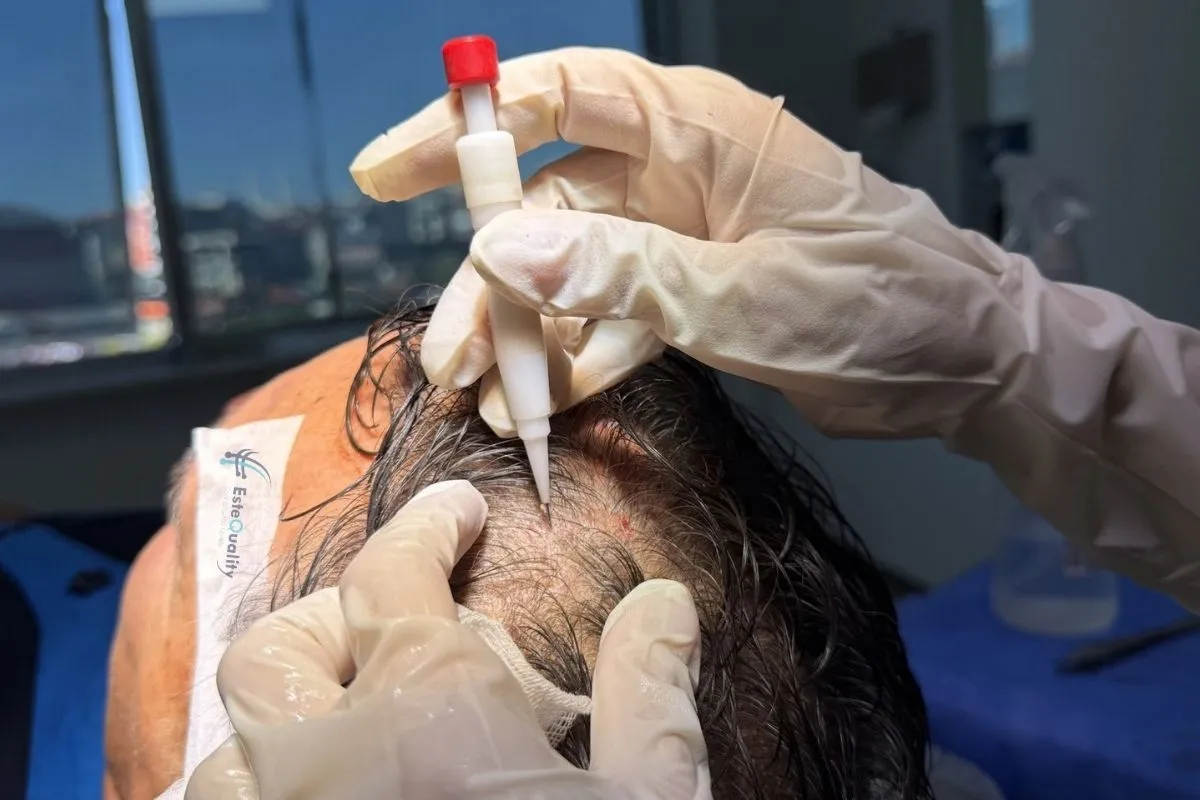
DHI stands for direct hair implantation. It is a form of follicular unit extraction (FUE): individual follicular units are removed one by one from the donor area, then placed in the thinning area [3]. What makes DHI distinct is the tool used to place the grafts. Instead of first opening the recipient channels and then inserting grafts as a separate step, DHI uses an implanter pen (often called a Choi pen): each graft is loaded into the pen, and the pen opens the site and sets the graft in one motion. In practice this gives the physician close control over the angle, direction, and depth of each hair, which matters most along the hairline.
Because the site is opened and the graft placed together, grafts may spend less time outside the body between extraction and placement, and the physician can work at a controlled depth and density. The one-step placement that gives DHI its control also makes it slower, so it is often applied to the hairline and smaller or unshaven areas. Full details are on our DHI hair transplant page.
What is Sapphire FUE?
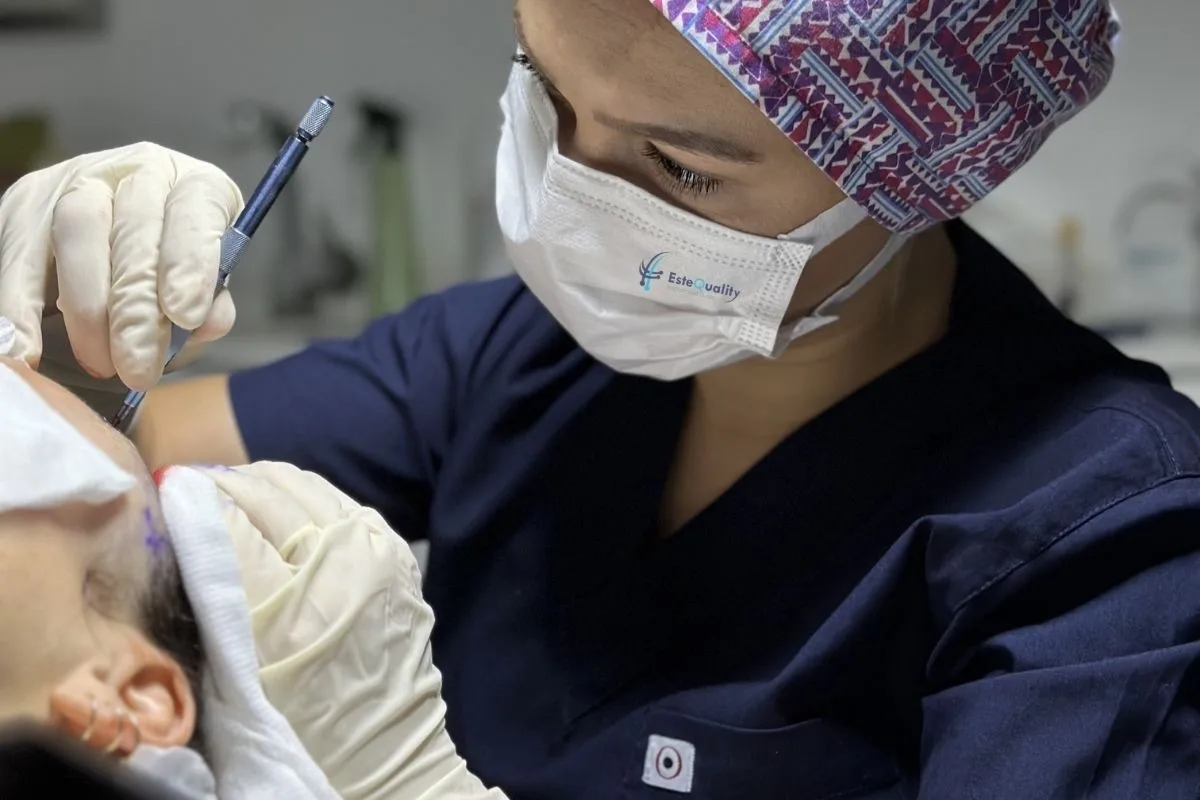
Sapphire FUE is a version of FUE in which the recipient sites are made with a blade cut from sapphire rather than steel [1]. Everything else follows the familiar FUE pattern. The idea behind it is precision: a sapphire tip can be shaped very finely and stays sharp through a long session, which lets the physician open smooth, consistent channels and place grafts closely together. That is why sapphire FUE is often chosen for dense, natural-looking work along the hairline and mid-scalp.
What the blade does not change is the biology underneath. How many grafts take, when they shed, and how the growth comes in are much the same as with a steel blade; healing is comparable [2]. The material makes precise work easier for a good physician, but the design of your hairline and the hand doing the work decide the outcome, not the blade. Full details are on our Sapphire FUE hair transplant page.
DHI vs FUE: where does standard FUE fit?
All three methods start the same way, with follicular units extracted one by one from the donor area. They differ only in how the grafts are placed [6]. In standard FUE the channels are opened with a steel blade and the grafts are placed as a second step; Sapphire FUE swaps the steel blade for a sapphire tip; DHI merges the two steps with an implanter pen. So “DHI vs FUE” and “Sapphire FUE vs FUE” are the same question asked from two sides: which refinement of FUE suits the area being treated. Neither is a separate surgery, and neither changes the harvesting, the shedding or the timeline of regrowth.
DHI or Sapphire FUE: which one should you choose?
There is no single method that is best for everyone. The right choice depends on your hairline, the area treated, and your hair type, and on the physician’s judgment, not the brand name of a tool.
Choose DHI, or a DHI component, when angle control matters most: the hairline and temples, adding density between existing hairs, and cases where you want to avoid shaving the recipient area.
Choose Sapphire FUE when the goal is clean, dense channel work across a broad area, or when the graft count is large and session time matters.
Many plans combine the two: sapphire channels across the broad area and a DHI implanter pen for finer detail. The two are complementary rather than rivals.
We match the approach to your case at the assessment instead of leading with a technique name. If DHI or sapphire is the wrong call for your donor supply or your pattern of loss, we tell you directly.
Who is a good candidate for either?
Both techniques relocate the hair you still have; they do not grow new hair. Good candidates usually have hair loss that has settled into a recognizable pattern, enough density at the back and sides to cover the thinning zones [2][4], and a realistic idea of what a transplant can do. Hold off if your loss is still advancing fast, if there is too little donor for the area you hope to cover, or if a medical cause behind the shedding has not been excluded first [5]. The technique does not change those fundamentals.
Recovery: does DHI heal faster than Sapphire FUE?
Not in a way you should plan around. Because no channels are pre-cut in DHI, some patients expect no scabbing or instant results; that is not the case. DHI heals like other FUE methods, with the same early shedding and the same gradual growth. Equally, because sapphire channels can be made smaller, some clinics promise noticeably faster healing; there is no strong evidence to count on that, so plan for the ordinary FUE path and treat quicker healing as a bonus if it happens [2]. With either method, the transplanted hairs shed between day 15 and day 30 before the follicles regrow, new growth begins around month 3 to 4, and the result is judged at around 12 months [7][3]. Our day-by-day recovery photos show what that looks like.
Cost: is DHI more expensive than Sapphire FUE?
Slightly, and by a fixed amount. At EsteQuality the price follows the graft count and the package you choose; DHI then adds a technique supplement of €200 for sessions up to 3,000 grafts and €500 for sessions above 3,000 grafts, because graft-by-graft implantation takes more physician time. Nothing else changes: the same packages, the same follow-up and the same 12-month review apply to both methods. Sapphire FUE procedure-only pricing starts from €1,700, and all-inclusive packages range from €2,100 to €4,200, updated September 2026; with the supplement, DHI packages stay within the same €2,100 to €4,200 range. The full breakdown is on our hair transplant packages in Turkey page. If a clinic quotes a much larger premium for one technique, ask what else is behind the figure: the physician, the plan and the follow-up.
How your treatment is supervised
Under the leadership of a plastic surgery specialist (plastic, reconstructive and aesthetic surgery), the planning and hairline design are carried out by physicians certified in hair transplantation [1], inside a fully equipped hospital environment. The physician performs the donor extraction and channel opening. In FUE and Sapphire FUE, implantation is carried out by the trained team under physician supervision; in DHI, the physician places the grafts with the implanter pen. The stay in Istanbul, screening, operation report and revision policy are set out on our hair transplant in Turkey page.
Frequently asked questions
Sapphire FUE vs DHI: which is better?
Neither is better in every case. DHI can help with angle control and with smaller or unshaven areas; Sapphire FUE may suit larger sessions and dense channel work across a broad area. We recommend a method after assessing your scalp, and many plans combine both.
DHI vs FUE: what is the difference?
DHI is a form of FUE. The grafts are extracted the same way; the difference is that DHI uses an implanter pen that opens the recipient site and places the graft in one step, giving fine control over angle and direction [3][6].
Which technique is better for a natural hairline?
DHI gives close control over the angle and direction of each hair, which matters most along the hairline; Sapphire FUE also delivers a natural hairline when the channels are opened at the right angle and depth. The design and the hand doing the work decide the outcome, not the tool.
Which is better for the crown or for large areas?
It depends on whether the area still has hair. Where hair remains and grafts must go between existing hairs, as in a thinning crown or mid-scalp, DHI is our usual choice: the implanter places each graft directly without pre-cut channels around the hair you keep. Across bald areas with no existing hair to protect, Sapphire FUE is the practical choice, because the two-step method covers large graft counts faster. Many plans use both in one session.
Which leaves fewer marks?
The same. Both are FUE, so both leave tiny dot marks in the donor area, and the recipient openings heal without visible scarring in either method.
Can DHI and Sapphire FUE be combined in one session?
Yes. Some plans use sapphire channels across the broad area and a DHI implanter pen for finer detail; the two are complementary rather than rivals.
Do I need to shave my head for DHI or Sapphire FUE?
In many DHI cases, no: the donor area is trimmed while the recipient area is left longer. It depends on the number of grafts and the area treated, and it is harder for large cases. See our unshaven hair transplant page.
Is DHI or Sapphire FUE painful?
Both are done under local anesthetic, so you should not feel pain once the area is numb; you may feel the anesthetic injections. The day is long, with breaks. Some tenderness afterward is normal and settles quickly.
How long does each procedure take?
It depends on the number of grafts. Because DHI places one graft at a time in one step, it can take longer than a comparable Sapphire FUE session; a large session usually takes most of a day with either method.
How much does DHI or Sapphire FUE cost in Turkey?
Sapphire FUE: procedure-only from €1,700; all-inclusive packages from €2,100 to €4,200, as of September 2026. DHI: the same packages plus a fixed technique supplement of €200 up to 3,000 grafts or €500 above 3,000 grafts, still within the €2,100 to €4,200 range. The full breakdown is on our hair transplant packages page.
Which technique is better for women?
Women often prefer approaches that avoid shaving the recipient area, which favours DHI for targeted density work; where the area is more extensive, Sapphire FUE may be recommended. See our hair transplant for women page.
How do I know which technique is right for me?
Send two photos on WhatsApp. We assess the donor area, the pattern of loss, the area to be treated and the density you want, and recommend a method or a combination for your case.
Written by Çağrıbey İslamoğlu, Healthcare Operations Director · Medically reviewed by Dr. Serhat Çehreli, MD · Last reviewed 24 September 2026 · Editorial Policy
Sources
- [1] ISHRS, Hair transplant surgery must be performed/supervised by a licensed physician; FUE variants.
- [2] AAD, Hair transplant: what to expect, grafts, shedding and regrowth timeline; healing comparable across FUE variants.
- [3] AAD, Hair transplant / DHI: what to expect.
- [4] NHS, Male and female pattern baldness; when the pattern stabilizes.
- [5] NHS, Causes of hair loss (pattern loss vs telogen effluvium / medical causes).
- [6] ISHRS, FUE variants (DHI implanter pen vs channel-first FUE / Sapphire) as refinements of follicular unit extraction.
- [7] NHS / Mayo Clinic, Risks of hair transplant surgery (swelling, infection, folliculitis, shock loss).


