
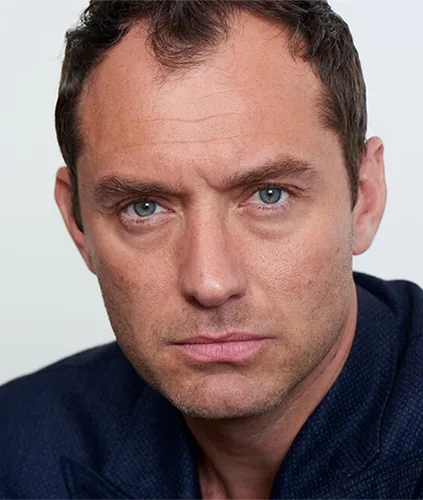
Jude Law has never confirmed getting a hair transplant. However, based on his visible hair loss pattern, primarily Norwood 3–4 temple and frontal recession, if he had undergone a transplant, it would most likely involve 1,800–3,000 grafts, using the FUE method , which is the gold standard for natural hairline restoration. This approach would rebuild the temple structure, restore frontal density, and maintain a mature, age-appropriate hairline. Full results from such a procedure typically become visible within 9–12 months and remain permanent.
Jude Law–Type Hair Loss Pattern
| Area | Purpose | Estimated Grafts | Most Suitable Method |
| Temples | Close recession and rebuild corners | 800–1,200 grafts | FUE |
| Frontal hairline | Restore density and structure | 800–1,200 grafts | FUE |
| Density refinement | Blend with existing hair | 200–600 grafts | FUE or DHI |
| Total Estimate | Full natural restoration | 1,800–3,000 grafts | Primarily FUE |
Did Jude Law Get a Hair Transplant?
There is no confirmed evidence that Jude Law ever had a hair transplant. Unlike some celebrities who openly discuss hair restoration, Jude Law has never publicly acknowledged undergoing any surgical procedure. This is important because hair transplants produce permanent results , and his hair loss pattern has continued to progress over time.
If a transplant had been performed early, the frontal hairline would likely remain stable. Instead, Jude Law’s hairline has gradually receded over the years — a pattern consistent with untreated genetic hair loss.
This strongly suggests that his hair density changes were influenced by:
- Natural hair loss progression
- Hairstyling techniques
- Lighting and camera angles
- Possible non-surgical treatments not surgical restoration.
Why Jude Law’s Hair Loss Drew Public Attention
Jude Law became widely known in the early 2000s for his thick hair and defined hairline , which framed his facial features and became part of his recognizable appearance. As his career progressed, however, gradual recession became noticeable particularly in the temple areas.
This type of change is extremely common and medically predictable.
Hair loss typically begins in:
- The temples
- The frontal hairline
- The crown (later stage)
In Jude Law’s case, the primary pattern was frontal and temple recession , not crown loss. This is one of the most recognizable forms of androgenetic alopecia.

Jude Law Hair Loss Timeline: How His Hairline Changed Over Time
Jude Law’s hair loss did not occur suddenly. It followed a gradual, medically typical progression seen in millions of men with genetic hair loss. Understanding this timeline helps explain why his case is widely discussed and why it does not match the pattern of someone who had a transplant.
Early Career (1999–2005): Strong Hairline With Early Temple Maturity
During the late 1990s and early 2000s, Jude Law had:
- Dense frontal hair coverage
- Minor natural temple maturation
- No visible crown thinning
At this stage, his hairline was still considered full and youthful , with only minimal changes expected with age.
Mid Career (2006–2015): Noticeable Temple Recession
This period marked the most significant visible change.
Key observations included:
- Deepening recession at both temples
- Increased forehead exposure
- Reduced density in the frontal region
This stage corresponds to Norwood 2 progressing into Norwood 3 , which is the most common stage where men begin considering hair restoration.
Recent Years (2016–2024): Stable Norwood 3–4 Pattern
In more recent appearances, Jude Law’s hairline stabilized into a pattern consistent with Norwood 3 to early Norwood 4 .
Characteristics include:
- Clear temple recession
- Preserved mid-scalp density
- No aggressive frontal reconstruction
Importantly, there has been no sudden restoration of the hairline , which would be expected after a transplant.
Hair transplants do not reverse themselves. Once grafts grow, they remain permanent.
The absence of a restored frontal line strongly suggests no surgical intervention occurred.
What the Norwood Scale Reveals About His Case
The Norwood scale is the medical standard used to classify male pattern baldness.
Based on visible progression, Jude Law’s hair loss fits into:
- Norwood 2 → Early temple recession
- Norwood 3 → Significant frontal recession
- Norwood 3–4 → Mature, stabilized hairline
This is one of the most common long-term patterns in men with genetic hair loss.
Importantly, this stage is also highly treatable with modern hair transplant techniques .
If Jude Law Had a Hair Transplant, How Many Grafts Would He Need?
Based on his visible hair loss pattern primarily frontal and temple recession (Norwood 3–4) the graft requirement would be considered moderate , not extreme.
Typical Graft Estimate for Jude Law–Type Hair Loss
| Area | Purpose | Typical Grafts |
| Temples | Close recession gaps | 800–1,200 grafts |
| Frontal hairline | Restore structure and density | 800–1,200 grafts |
| Density refinement | Blend with existing hair | 200–600 grafts |
| Total | 1,800–3,000 grafts |
Why Frontal Hairline Restoration Requires Precision
Frontal hairline work is the most technically demanding type of hair transplant.
Every graft must be placed with:
- Correct angle
- Correct direction
- Correct density transition
The frontal hairline defines facial balance. Poor planning results in an unnatural look, even if graft survival is successful.
In Jude Law’s case, restoration would focus on:
- Closing temple recession
- Rebuilding the frontal corners
- Preserving a natural mature hairline not creating a juvenile hairline.
Which Method Would Be Most Suitable? (FUE vs DHI)
For frontal recession cases like Jude Law’s, FUE is the most commonly preferred method .
FUE (Follicular Unit Extraction) — Most Likely Choice
FUE allows:
- Precise placement across wider frontal zones
- Natural density gradients
- Minimal visible scarring
It is particularly effective for restoring temple areas and rebuilding hairline structure.
This method provides the most flexibility when reconstructing mature hairlines.
DHI (Direct Hair Implantation) — When It Is Used
DHI can be useful for:
- Density refinement between existing hairs
- Small, localized corrections
- Increasing density without shaving large areas
However, for larger frontal restoration zones, FUE generally provides more efficient coverage.
Why Conservative Planning Produces the Best Results
The best hair transplants are not obvious.
Natural results depend on:
- Age-appropriate hairline design
- Proper graft distribution
- Long-term planning
A conservative, medically accurate approach ensures the hair continues to look natural as the patient ages.
This is especially important for public figures, whose appearance is constantly visible.
Non-Surgical Factors That Can Affect Hair Appearance
Temporary improvements in hair appearance can occur without surgery.
These include:
Hair Length and Styling
Longer hair creates overlapping layers, reducing scalp visibility.
Lighting Conditions
Strong overhead lighting increases scalp contrast, while softer lighting reduces visibility of thinning.
Hair Cycle Variability
Hair naturally cycles between growth and shedding phases, which can temporarily change density appearance.
These factors can create the illusion of improvement without actual follicle restoration.
How Modern Hair Transplants Restore Hairlines Like Jude Law’s
Today’s advanced techniques allow precise restoration of frontal recession while maintaining natural aesthetics.
For Norwood 3–4 cases, modern procedures focus on:
- Reconstructing temple structure
- Restoring frontal density
- Preserving donor area integrity
Techniques such as Sapphire FUE and DHI allow natural-looking results with minimal downtime.
How Estequality Restores Natural Hairlines
At Estequality, hair restoration is planned based on individual hair loss patterns, donor capacity, and long-term progression.
Each procedure focuses on:
- Natural hairline design
- Correct graft angulation and density
- Preservation of donor resources
Techniques such as Sapphire FUE and DHI are selected based on the specific needs of each patient.
The objective is always the same: restoring density without creating an artificial appearance.
Frequently Asked Questions About Jude Law Hair Loss
Did Jude Law get a hair transplant?
No, Jude Law has never confirmed getting a hair transplant. His hair loss has followed a gradual and natural progression consistent with genetic male pattern baldness, without any clear signs of permanent surgical restoration.
How many hair transplants has Jude Law had?
There is no confirmed evidence that Jude Law has had any hair transplant procedures. If he had undergone one, his frontal hairline would likely appear permanently restored rather than continuing to recede gradually over time.
Does Jude Law take finasteride?
There is no public confirmation that Jude Law uses finasteride. However, finasteride is a common medical treatment for male pattern baldness and is often used to slow further hair loss in similar cases.
How did Jude Law grow his hair back?
Jude Law has not permanently regrown his hair. Any temporary improvements in appearance were most likely due to hairstyling, lighting, or natural hair cycle variations rather than surgical or permanent medical restoration.
What stage of hair loss does Jude Law have?
Jude Law’s hair loss is consistent with Norwood Stage 3–4 , primarily affecting the temples and frontal hairline. This stage is very common and can be permanently restored using modern hair transplant techniques such as FUE.
Jude Law is not affiliated with EsteQuality and has not endorsed our clinic. This article discusses publicly available information and speculation.
