
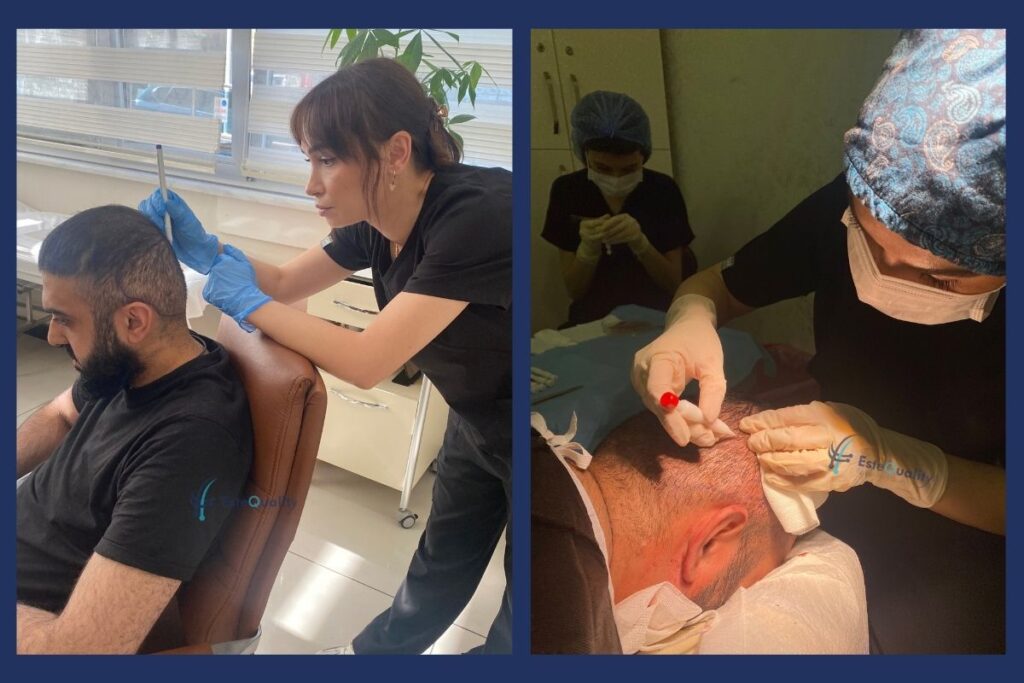
TL;DR: An overharvested donor area develops when extraction removes more follicular units than the donor zone can visually tolerate. Extracted follicles do not regenerate, so treatment aims to reduce visible patchiness and improve blending rather than recreate the original biological density. Depending on the remaining donor supply, hair and skin characteristics, scar quality, and preferred haircut, repair may involve carefully placed scalp or beard grafts, scalp micropigmentation (SMP), or a combined plan.
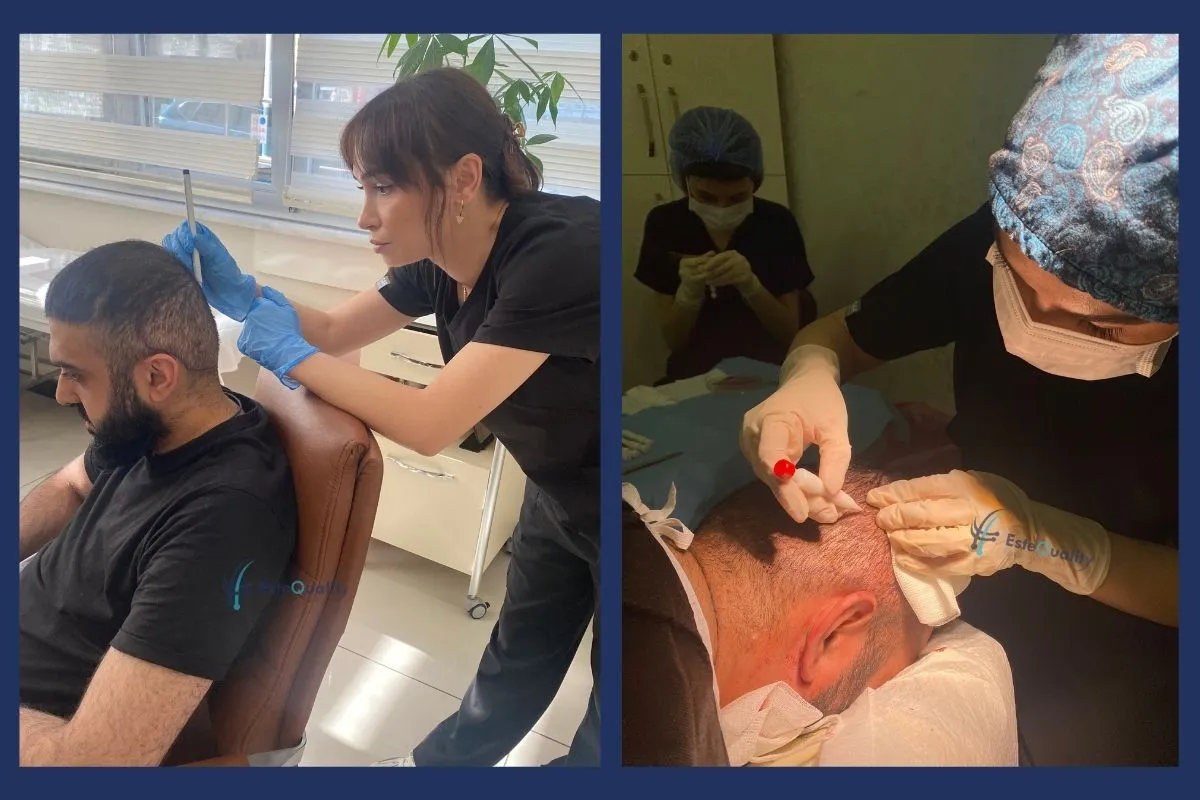
What Is an Overharvested Donor Area?
An overharvested donor area means that more grafts were taken from the back of the head than the scalp can safely supply. Normally, this zone should still look natural after extraction. But when it’s overused, it becomes visibly patchy and thin.
Typical signs of overharvested donor area include:
- Uneven or missing hair in the donor zone
- Shiny or scarred skin that no longer grows hair
- Poor blending between extracted and untouched areas
- The donor region looking worse than the recipient area itself
- Thinning that shows mainly with short hair, stays limited to where grafts were taken and does not fill in over time.
Why Does Donor Area Overharvesting Happen?
Overharvesting usually happens because the clinic ignores donor capacity and extracts more grafts than the scalp can safely provide. This is a preventable complication of poorly planned FUE surgery.
Main reasons include:
- No detailed donor analysis before the operation
- Taking too many grafts in one session
- Random extraction without proper spacing
- Using a punch size that is unnecessarily large for the patient’s follicles and skin
- Repeated extractions from the same zone in revision procedures
- Inadequate medical planning or clinical oversight
When this happens, the donor area loses density and looks patchy or “moth-eaten.” In severe cases, the skin becomes shiny or scarred meaning the follicles can no longer grow back.
EsteQuality’s approach: Each donor area is mapped before extraction. Density, hair caliber, scalp characteristics, previous procedures, and the size of the safe donor zone are considered to calculate a patient-specific range and reduce the risk of visible depletion.
How Many Grafts Can Be Extracted from the Donor Area Safely?
There is no single safe graft number that applies to every patient. The same graft count can be well tolerated by one donor area and visibly deplete another.
A safe extraction plan should consider:
- Follicular-unit density per square centimeter
- Hair shaft thickness, curl, and the number of hairs in each graft
- Contrast between hair and skin color
- The dimensions of the permanent donor zone
- Previous extractions and the spacing between them
- The patient’s preferred hair length after surgery
A peer-reviewed overview of follicular extraction reports that many FUE experts use approximately 10–15 excisions/cm² in a single pass when baseline density is around 65–75 follicular units/cm². This is a technical planning reference, not a personal graft quota or a universal lifetime limit.
The donor area is finite. A responsible plan protects enough visible density for the current procedure, future hair loss, and any revision that may be needed later.
How Does the Donor Area Look After Hair Transplant?
After a properly planned FUE, the initial donor healing generally progresses over the first 2–3 weeks, while the surrounding hair begins to cover the small extraction points. However, in overharvested cases, the situation looks very different.
Typical appearance of a damaged donor area:
- Patchy or uneven density
- Visible empty gaps between follicles
- Shiny or scar-like surface
- Lighter skin tone compared to surrounding areas
- Noticeable contrast when hair is cut short
Patients often describe it as “my donor looks worse than the area I had transplanted.” This visual imbalance can indicate that extraction exceeded the donor area’s visual capacity, although early postoperative shock loss must also be considered.
At EsteQuality Hair Transplant Clinic in Istanbul, we assess density, hair caliber, extraction pattern, scalp texture, and scar contrast before planning a repair. The goal is to improve balance without creating further depletion in another donor zone.
Is It Overharvesting or Temporary Donor Shock Loss?
A donor area should not be diagnosed as permanently overharvested from redness or early shedding alone. Temporary shock loss can affect hairs around extraction sites, whereas overharvesting reflects a lasting shortage or poor distribution of follicular units.
- Temporary shock loss usually appears as diffuse shedding around the treated area and may improve as affected follicles return to their growth cycle.
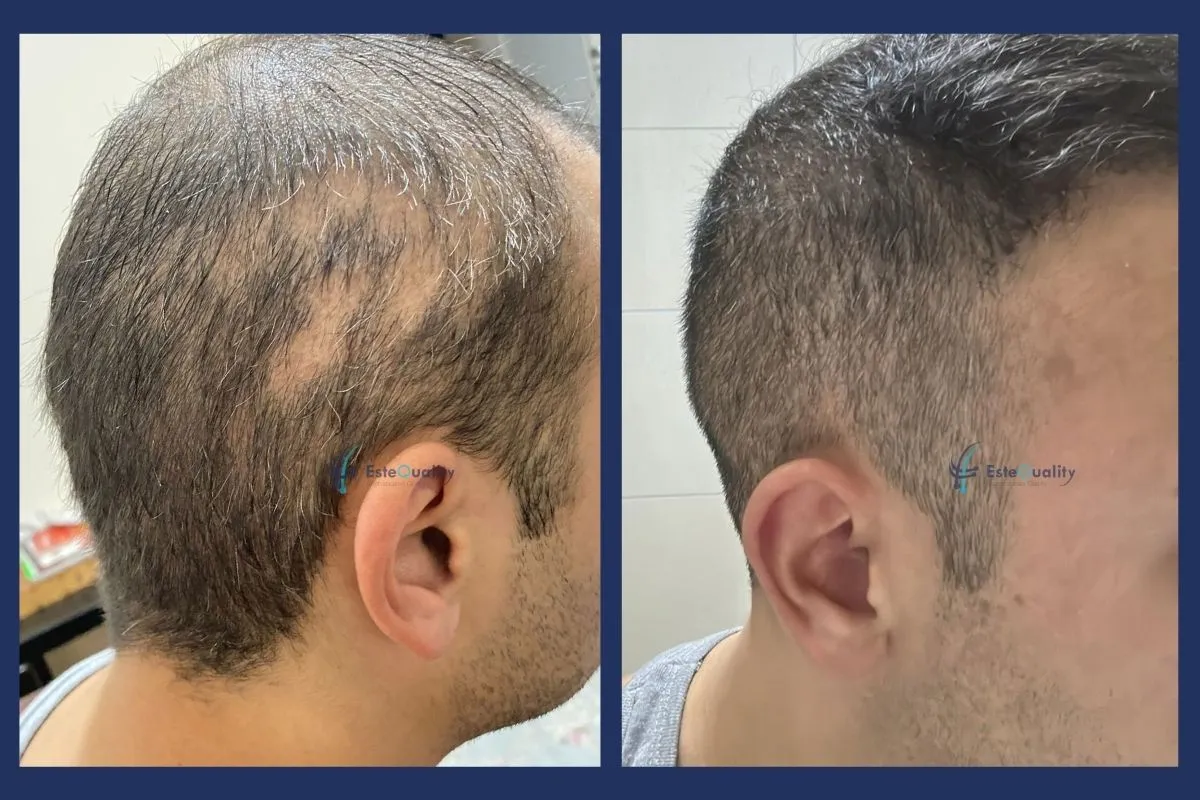
- Overharvesting is more likely to leave persistent patchy density, clustered empty zones, visible dot scarring, or a moth-eaten pattern after the donor has matured.
- Comparable photographs should use the same haircut length, lighting, angle, and hair dryness; otherwise, contrast can exaggerate or hide the problem.
Pain that is increasing, pus, spreading redness, darkening skin, or an open wound is not a normal density concern and requires prompt medical assessment.
Overharvested Donor Area Repair Options
The appearance of an overharvested donor area can often be improved, but the correct method depends on the remaining donor capacity, scar texture, hair-to-skin contrast, and the haircut the patient wants to wear. The main options are follicular repair, SMP, or a combined plan. At EsteQuality, follicular repair with beard grafts comes first; SMP is a second step for any contrast that remains. How we assess a case, where the grafts come from and what it costs are set out on our donor area repair page.
1. Donor Hair Transplant (FUE or DHI Repair)
If suitable follicles remain in another donor source, carefully selected grafts can be implanted into the most visible gaps. Scalp hair is preferred where the match is appropriate; beard or selected body hair may be considered when scalp reserves are limited.
In selected patients with adequate beard density and a suitable under-chin donor zone, EsteQuality can plan up to 2,500 beard grafts. This is not available or necessary in every case: hair caliber, color, curl, extraction safety, and the area requiring repair must match the plan.
Potential benefits:
- Adds real hair coverage where graft survival is medically feasible
- Uses the patient’s own follicles
- Can reduce contrast when direction, spacing, and hair characteristics are matched carefully
2. Scalp Micropigmentation (SMP)
SMP places pigment between existing hairs to reduce the color contrast created by pale extraction marks or low density. It does not grow new hair, and the pigment can fade or require future adjustment.
Potential benefits:
- Can provide earlier visual camouflage than transplanted hair growth
- Usually involves less downtime than another surgical procedure
- Can help blend linear or dot-like scars with a short hairstyle
3. Combined Repair (FUE + SMP)
A combined plan may be appropriate when limited grafts can improve the most visible gaps but cannot safely rebuild the entire depleted zone. Follicular repair adds real hair in selected areas, while SMP reduces the remaining skin-to-hair contrast.
EsteQuality Case Study: Donor Repair After Failed Operation
This patient came to EsteQuality after a failed hair transplant performed at another clinic. During the previous surgery, the donor area was overharvested, leaving visible gaps and almost no regrowth. The scalp appeared thin and irregular, especially in the central donor zone.
At EsteQuality, we performed a donor repair hair transplant, carefully adding grafts to selected depleted areas to improve coverage and blending. Every extraction and implantation was planned with measured spacing and consistent direction to protect the remaining follicles and improve overall symmetry.
Key outcomes:
- Donor area visibly thickened and balanced
- Natural blending with existing hair
- Repair planned without further aggressive harvesting from the depleted zone
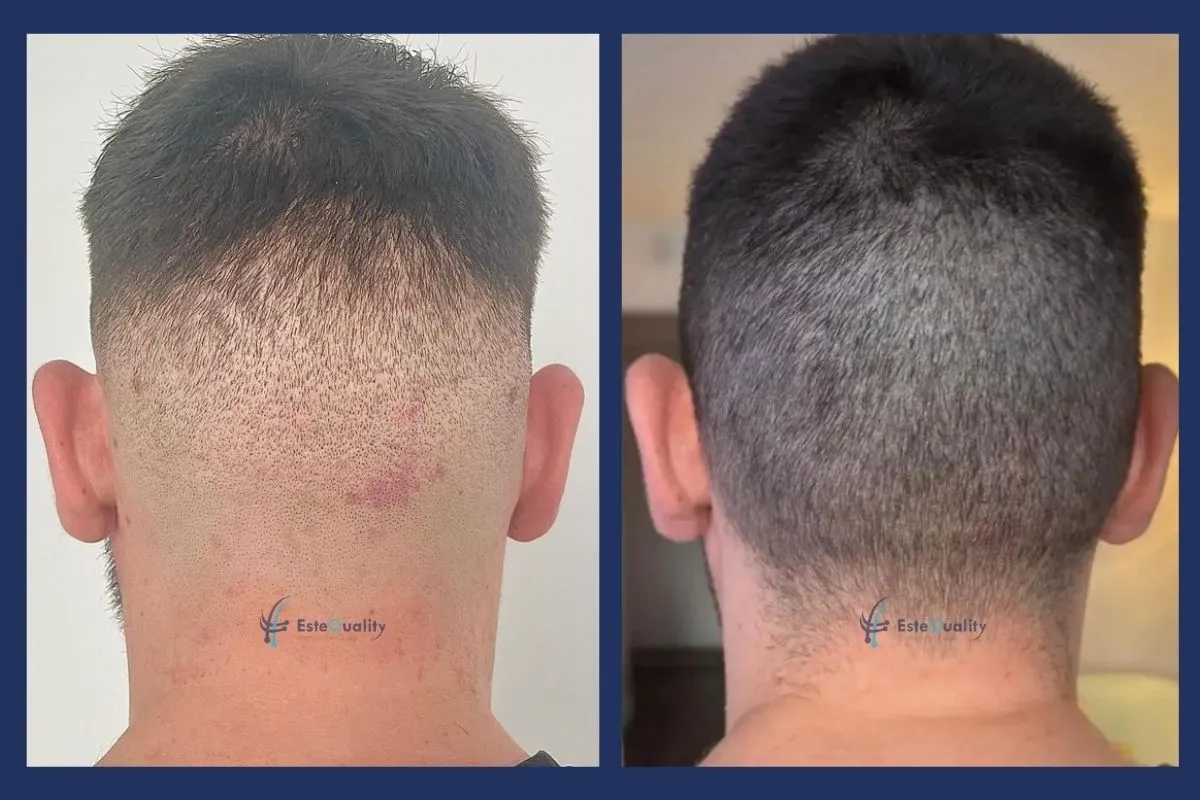
The full case, with the 12-month result, is on the donor area repair page.
How to Fix an Overharvested Donor Area, and What Is Realistic
No, not biologically. Follicles that were extracted or permanently destroyed do not regenerate. Repair can reduce patchiness, improve coverage, and make scars less conspicuous, but it cannot promise the original donor density or a fixed percentage of visual restoration.
At EsteQuality, the objective is a measurable improvement in blending and density distribution. The plan must also protect every remaining donor source, because attempting to chase complete coverage can create a second depleted area.
Common Questions About Donor Area Repair
1. Can I have another hair transplant if my donor area was overharvested?
Possibly, but only after the remaining scalp, beard and any other donor sources have been measured. To bring a donor area back to how it looked before extraction, roughly as many grafts as were removed would have to be put back, and that supply is rarely available; a further scalp extraction may also be unsafe when density is already low. The first route is therefore beard-to-donor repair. If you want to wear your hair very short, send us photos on WhatsApp showing your scalp and the beard under your chin, and we will tell you, free of charge, whether your beard holds enough grafts. If the donor still looks uneven after a beard-to-donor repair, SMP can be added later as a second step; it complements the repair rather than replacing it. We plan this step by step on our donor area repair page.
2. How long does it take for an overharvested donor area to heal after repair?
Initial healing after follicular repair usually progresses over the first few weeks, but transplanted hair develops gradually and the final visual assessment commonly requires 6–12 months. SMP provides earlier camouflage, although pigment also needs time to settle.
3. Is SMP safe for a previously transplanted donor area?
SMP can be used over selected healed donor scars when performed with sterile technique and an appropriate pigment plan. It does not repair follicles, and risks such as infection, pigment migration, allergy, color mismatch, or fading should be discussed first.
4. How can I reduce the risk of donor overharvesting?
Choose a physician-led team that measures donor density, maps the permanent donor zone, distributes extractions evenly, records previous harvesting, and plans for future hair loss instead of focusing only on the largest possible graft number.
5. What results can I expect after donor repair?
The realistic goal is a more balanced and less patchy appearance. The amount of improvement depends on the remaining donor supply, scar visibility, graft survival, hair characteristics, and the haircut used after treatment.
6. Do extracted donor follicles grow back after FUE?
No. Once a complete follicular unit has been extracted, that follicle does not regrow in the donor site. Nearby unextracted hair can grow longer and cover extraction points, but it does not replace the removed follicles.
7. How can I tell shock loss from permanent overharvesting?
Shock loss tends to be diffuse and may improve as affected follicles re-enter growth. Overharvesting is more likely to leave persistent geometric gaps, clustered low-density zones, or visible scarring after the donor area has fully healed. Trichoscopy and comparable photographs help distinguish them.
8. How soon should an overharvested donor area be assessed for repair?
An early medical review is appropriate if healing appears abnormal, but a definitive density and repair plan should usually wait until swelling, redness, haircut differences, and temporary shedding no longer distort the assessment. Many surgical revisions are planned only after the previous procedure has matured.
9. Can minoxidil repair an overharvested donor area?
Minoxidil cannot replace follicles that were physically removed. A clinician may consider it when temporary shock loss or miniaturization also affects existing hairs, but it is not a substitute for graft redistribution, SMP, or another appropriate repair method.


